Pages

Sunday, 3 November 2013

Social Media Bringing Life to the Church

A Presentation to the Federation of Finnish-British Societies 
 The British Embassy, Helsinki
25th October 2013

Social Media Enhancing Well Being.

In this presentation I want to concentrate on the use of social media to promote relationships and projects which happen in time and space that it not digital. I think that the distinction often made between the 'real world' and 'digital world' is false. Things that profoundly affect our lives happen in both spheres - digital and non-digital - and the church must respond to this and, more than simply responding, give some help and leadership in thinking about the ways the one sphere influences and shapes the other. And let us not be afraid. We have a God who became incarnate as Word so Christians above all ought not to be afraid of exploring new forms of communication. 

I confess to you at this point that I am no expert. In 2010, I knew next to nothing about the phenomenon we now call social media. I had never used Facebook or Twitter and I was one of the brigade who secretly thought they were probably a bit of a waste of time. Then came a snowfall. Now in Finland that would have been unremarkable, but in Britain the lightest of snowfalls causes a crisis; roads become unusable, trains fail to run, schools close and the whole country grinds to a halt! I used what was, for us, a heavy snowfall in November 2010 to stay indoors and start a blog. I had been encouraged to do this by David Brighton, our Diocesan Webmaster, and I shall be eternally grateful to him for setting me off on a new new adventure. My message is that anybody can learn to use social media; the opportunity to use it for good rather than for harm is there for the taking.

My use of social media in my ministry has not been about generating large numbers of followers or about getting huge numbers to read what I'm writing. I have not even actively promoted interaction online as I have known that I've had little time to read and moderate comments, though I am always grateful to receive them. The focus of my use of social media has always been about building relatively small communities of interest that make a difference. I'll repeat that - 'relatively small communities of interest that make a difference.' These have been communities with a common purpose that can get things done and/or offer support. A large part of my use of social media has been about increasing trust between people. Today I'm going to give you 6 examples of how that can happen, some examples are my own work and some the work of others or the work of several people as so often happens on the internet when one person picks up another's idea, adds to it and runs with something new.

First, however, a warning from history!


Anne and some of her court were, of course, eventually tried and executed for treason and alleged adultery. Anne was beheaded after short months of marriage to Henry. What started as harmless fun and something to bring the court together ended in tragedy. Perhaps there is a lesson here for us all. Never say anything on social media that you would not own up to before God or defend in a court of law. Remember that what you write will be read in many cultures and at times in the future when you no longer agree with what you once wrote or you are even no longer alive. It can go viral in a matter of about three seconds. Never write anything when you are angry or after you have had more than one glass of wine! All bloggers know that slightly queasy feeling of watching the page views on your blog suddenly leap up by 100's of views per minute, 'O heavens, what have I said?' I'm grateful to Tom Standage for this insight from Anne Boleyn's life. Tom is currently writing a book about the history of social media Writing on the Wall, to be published shortly and he has an interesting facebook page dedicated to the use of various forms of social media here


These are the forms I am familiar with. I use Twitter for political comment and regional networking, supporting local causes, events and interest groups, and promoting tourism  in the area. I also use it to direct people to my blog. Facebook I use to stay in touch with friends and particularly with former students. I think that I am probably part of the first generation of university lecturers that has been able to follow the career paths and ministries of many of my students and this is a constant source of pleasure as well as helping me to do my job and to find resources! I also use Facebook to point people to my blog but I try not to overdo this as not everybody goes on Facebook to read blogposts! I use Linkedin exclusively for professional development and to join communities that will help me to increase my knowledge in my own field of expertise. Google+ I find scary - it appears to me to make links you didn't authorise or anticipate!


Archdeacon in the Dales is the blog I started in 2010 when I was Archdeacon of Richmond, a geographically large archdeaconry with a very rural character. The area had around 187 churches and it was difficult to visit them more than once or twice every couple of years, if that often. Using the blog, I set out to do the following -


To date, the blog has had over 78,000 page views. I purposely did not use Twitter or Facebook to promote it. The readers to whom it was directed were largely church wardens and other church officers, many of whom were not used to social media and, in some cases, were highly suspicious of them. I decided that if I told them that the blog was like an electronic newspaper and that it was a source of useful information, this would be the best way to create local readership. This seemed to work, along with a link on the Diocesan website which a lot of people used.  


Archdeacon in the Dales allowed me to say things about subjects I was interested in and that, in turn, allowed people to get to know me. This meant that when I arrived in a parish for a meeting, people often felt they knew something about me - we might even have had a conversation by e mail or through comments on the blog or one of the diocesan chat rooms. You can read the blog here


One of the interest groups that grew out of Archdeacon in the Dales was provoked by a review I wrote of this book


Lisa Genova writes movingly about a university lecturer who realises that she has dementia. It is the story of her progression into the disease and, uniquely, it is  written from the view point of the person who has dementia. A blogpost about the book provoked a number e mail responses in which people told me their own stories of caring for someone in the family or the local community with dementia. With people's permission, I put some of these readers in touch and they are still supporting one another and also, many of them, now involved in local groups working for and with people who suffer from dementia.


Another inspirational story is that of Fun-key Church in the market town of Richmond itself. St Mary's Richmond is a fairly traditional parish church with a fantastic choral tradition - the choristers have won many Royal School of Church Music awards over recent years. Apart form the choir and a small Sunday School, the regular Sunday services largely attracted people aged over 50. Inspired by the vision and leadership of one exceptional mum, they have created an entirely new worshipping congregation in which parent-to-parent contacts and social media have played a great part. Their leader, Gillian Lunn, has used a blog, wordpress, facebook and twitter extensively to build up the fellowship and sense of community which surrounds the worship. In particular, the blog is used to create a sense of anticipation  - you'll see 'advertisements'  -  'two weeks to go to the Archbishops of York's visit', 'one day to go to our first baptisms', 'pet service today'. The blog describes exactly what to expect when you attend a service - if you were a parent new to the experience of coming to church and you read the relevant short blog post for a particular service you would know exactly what would happen and you would be able to explain it to your child. 


Fun-key is a project about growing the younger element in a parish.  It has close links with the schools and it has shown a great capacity to adapt and spread - there is now a Fun-key service in one of the nearby village churches. It is becoming well known around the area and also nationally as one example of what can be achieved through the use of social media and real-space-and-time worship. You can find out more here and here


Saxon Roots is another project which is spawning new forms of worship. This one centres on the crypt at Ripon Cathedral which was built in 672AD. There are numerous Saxon sites around North and West Yorkshire. I can take you to churches where there is Saxon masonry, a Saxon preaching cross, a Saxon pulpit or font and even the remains of what is through to be a Saxon bell. The deep roots of Christianity in the region are from the 6th and 7th centuries and these influences continue to  play a part in shaping Christianity in Yorkshire today, through the location of sacred sites and the stories that are associated with them and still told. 


The project is the idea of Nick Morgan of the Ripon Cathedral community. Nick has tapped into some research that is being done by a diocesan group to try to dig out the history of the saxon sites around the area. The aim is to understand and use elements of the Saxon Christian past to shape acts of contemporary worship. For example, in Saxon times there was often no church that could be used for worship in a village. People would gather round a preaching cross in the middle of the village where they would listen to a travelling preacher, participate in the sacraments and hear and discuss news about the life of the community. The first Saxon Roots service took place in Ripon cathedral at the end of October and the vision is to extend the project by holding acts of worship in other communities around the area. Here's Nick's very creative vision for doing that:


For information abut this project go to Saxon Roots Wordpress or the facebook page


The blog you are reading this lecture on, Social Horizons, is something that I started in May 2013. It's very important to have clear, idenifiable themes if you are going to build up readership on a blog. Social Horizons was inspired by the thinking of a colleague, The Revd Dr Peter Sedgwick, Principal of St Michael's Theological College in Cardiff. In discussing pluralism and the concept of society, he says this,

[William] Temple assumed that Christianity had a central role in society, but had to demonstrate its concern for social change. Contemporary ethicists may take the concept of reform as inherent to Christianity, but they have to ensure that the Christian faith has any credibility at all in modern British society and politics. In a pragmatic, pluralist, technologically driven world, that is a very considerable challenge.

In the blog, I set out to explore the connections - I wanted to call it 'Only Connect', but that blog title had already been taken - between social justice, community development and theology. My husband, who works in an industry that spends most of its time thinking about the future, once asked me why the church spends so much time thinking and talking about the past. Social Horizons is a blog that sets out to call into play the imagination to help us think about the the future. If we explore concepts of community and justice and we relate them to aspects of the Christian tradition such as the imperative to live as brothers and sisters and the expectation that Christ will return and is therefore as concerned with the future as the past, we can expect to discover insight and energy for new shapes of social being. The old saying, 'We do not inherit the earth from our ancestors; we borrow it from our children,' is attributed variously to Indian and Amish sources and to Ralph Waldo Emerson. It rings true in most cultures and is at the heart of what I am about. The way we think about society today and the decisions we make are our gifts or burdens to pass on and we should be as motivated by what we make possible as by what we have achieved.

To this end, Social Horizons aims to promote the discussion of locally and nationally important issues. It attracts about 400 page views for each post and is advertised through twitter. For example, North Yorkshire has an ageing population and a higher than average incidence of dementia. There is also currently a national debate about end of life care both at a legal level (questions about whether the law should be changed to allow assisted euthanasia in some cases) and a clinical level (questions about something called the Liverpool Care Pathway which has been used by hospitals in the care of the dying but has recently come in for criticism.)  Blogposts connecting these topics have brought together professionals who are concerned with the issues in their daily work and the cross discipline discussions are proving useful to all concerned. This is an example of social media enabling people who would not normally come together to contribute joined-up thinking to an area of public life.


The last of my 6 projects was entirely the work of a colleague at the hospice where I work, The Revd Dr Jonathan Singh,  has recently written a thesis about a Lenten discipleship blog which was used to promote discipleship through the careful use of the narratives that were told by those who participated. About 15 people took part in a password-protected blog which was moderated by a small group of faith leaders. The aim of the experience was to help the participants move forward in their spiritual life and, of course, to allow them to help each other through the use of their own stories. The spiritual formation had clear goals, was aimed at the whole person and used a range of resources and tools to assist with personal transformation. It included opportunities to engage in the practice of the present moment, disciplines of simplicity, silence, fasting and solitude, study of the faith and memorization of key texts and participation in community life. The narrative of the whole project is itself fascinating and the thesis offers reflection on the effectiveness of the use of social media in this way as a tool for promoting mature and committed Christian discipleship. The project demonstrates, I think, an effective way for parishes to work among people of faith whose lives do not realistically or naturally bring them together with other Christians on a regular basis or in ways which allow them deep discussion or meaningful learning. 


There are, of course, limitations to the ways in which social media can be used. In particular, SM challenges our preconceived and powerfully held concepts of community and sacrament - two things that lie at the heart of Christian self-understanding. It is not possible to explore these within the scope of this presentation but it would be wrong not to flag them up as areas that need considerable attention and thought. It's often said that  community ties are weakened by the use of social media. I would argue that that is a an over simplification of a very complex area. Better to ask the question, 'In what ways does the use of social media change the ways we experience community?' I would suggest that the use of social media can be very helpful in helping to create relationship. For example I have used it in parishes where people would not come to the vicarage to talk about having their baby baptised without first having a detailed discussion about the nature and meaning of baptism by email - I doubt that without the initial relative anonymity of the internet there would have been any face to face contact or joining of the church community. On the question of sacrament, I think that the absolute requirement to meet will always lie at the heart of the Christian faith and this will always be a corrective to the impetus to use the internet as a replacement for time-and-space community. There is now a whole new discipline within theology (Haptic Theology) which is exploring questions about touch - where community forms without the immediacy of touch and smell, what does that mean for our humanness and for the ways in which God communicates with humanity through sacrament?


If you would like to explore these kinds of questions further, you might be interested in two projects that are seeking to help Christians make sense of the digital world and its influence on the ways that we think about life, faith and theology


Codec can be found here CODEC and the Big Bible project here Big Bible

In Conclusion
The most important thing to take away from today is that you do not need to be a great expert in the use of the internet to develop ways of interacting with it and through it that help us understand, practise and spread our faith. The message is 'try something small, monitor it carefully and see where it leads you!' Jesus came as Word into our world. There is, at the heart of God and at the heart of the incarnation, something which is essentially about communication. Christians are people of word and text and therefore intrinsically of communication. The internet, like any form of communication is, I believe, there to be used for good or for evil. It's essential that Christians take responsibility to learn to enter into communication through it in ways that speak powerfully of the Gospel and of the nature of God in Christ Jesus. The digital world is now as key to the shaping of life as the industrial revolution was or the dawn of printing or the realisation that the world was not flat. We should not fear it but embrace it critically. 

Finally, blogging, twittering, facebooking and all the other forms of media we have mentioned can sometimes appear to be about numbers - the blog that has millions of readers may be seen as more influential than the magazine that has a few thousand.  Time spent on the internet may be justified in terms of the number of people 'reached'. You may even worry about the amount of time your priest appears to spend in front of the computer screen or on the iPad!  However, I always maintain that we only count people because every person counts. My intention in using the internet has never been to generate huge numbers of readers but to make a lasting difference to a few. All the blogging and twittering I have ever done is made worthwhile by the one person who occasionally sits in my study and tells me how a real connection has been made, through the use of social media, that is truly life-giving. 

Wednesday, 30 October 2013

The Gender Gap

The World Economic Forum has just published its annual report here which shows that inequalities between women and men are gradually becoming fewer. If you can measure such things, then there has been, specifically, a 2% reduction worldwide in the past 12 months. The report caught my eye because Finland comes out as the second best country for equality between the genders, after Iceland, and I am in Helsinki as I write. While here, I've been reading the autobiography of Malala Yousafzai, written with Christina Lamb (published Weidenfeld  and Nicholoson 2013). I had no idea how much of a political activist she was, speaking about opportunities for women's education from a very early age - long before she became internationally known. In her society, people become adults at the age of 14 but Malala had been outspoken and active in the pursuit of girls' right to education long before she officially became an adult and then, as a woman, found her movement and freedom restricted in ways we can't imagine. At the age of 15, even though she continued not to veil her face, she felt had to send a younger girl who was still a child to buy a snack for her as it was not acceptable for her to be out on the street alone.The book gives a really  fascinating and detailed insight into the daily life of a family who are clearly bonded by love and by belief in the power of education for all. Although Malala's mother was not literate (she was due to begin a course to learn to read and write on the very day Malala was shot) she is an intelligent and deeply spiritual Muslim woman. For Malala, encouraged by her father who is a dedicated and passionate educator, to have achieved so much in a setting where she had enormous pressures to keep quiet, not least for her family's safety, is quite amazing. The book gives a surprisingly penetrating account of the political tensions in northern Pakistan and there is no sense that this is a naive story because it is told by one so young.


Published Weidenfeld & Nicholson 2013


The BBC has just completed its 100 Women Season with a conference for 100 leading women from around the world here Sigridur Maria Egilsdottir of Iceland gave a challenging address. Although she comes from the country where, for 5 consecutive years, the WEF has reported the lowest levels of inequality in the treatment of women, she encouraged her audience never to sit down and think the struggle is won. 70% of those living in absolute poverty in the world are women and 66% of those who are illiterate are female. Speaking of her own profession as a musician, Sigridur's painted the picture of a three generation family process - it took one generation of women to climb out of poverty, one generation to get an education and then a third to learn the instrument!  She urged us to continue to challenge 'society's deeply held view that women are somehow inferior' which leads to women being denied opportunities for education and proper health and maternity care, girl children being aborted and violence against women. You can see her full speech on the link above. She threw out a question you might like to think about, 'What message would you send to your granddaughter?' Her answer - 'get an education.' 


Icelandic Singer and Debater Sigridur Maria Egilsdottir
www.youtube.com 

Where are the best and worst places to be a woman? To see a comparison of the gender gap across the continents, go to 'Women gain as gender gap narrows' here   Of course, we might argue that we want to see the removal of poverty and the provision of education for all regardless of gender but the conference and Malala's book gave very powerful examples of why and how women suffer doubly because of their place (or lack of place) in society.


Sunday, 13 October 2013

EDL Defending Who From Whom?

Once upon a time it rained (quite a lot) in a peaceful northern city. A group of activists travelled to the city bent on defending the rights of the disenfranchised. About two hundred of them disgorged from trains, buses and cars onto the streets. But the people of the city went about their business in co-operation and harmony. The activists wandered about a bit. No one took any notice. The activists left. It rained some more. The end.

Not much of a story? What were the English Defence League doing in Bradford yesterday? Why did they think their presence was needed? And perhaps most intriguingly, what do they believe they are defending England from? When I walk around Bradford (or Leeds or Nottingham or Derby, for that matter) I am so intensely proud to be British. I relish the diversity of cultures and the sight of people of hugely different backgrounds enriching each others' lives through work and commerce and education. My husband and I have friends and colleagues of many faiths, languages and ethnic origins, all of them thoroughly British. In Bradford there is an extraordinary sense of entrepreneurship among the young. I don't want to romanticise things - there are times when different parts of the community remain isolated or aloof in ways you wish they wouldn't. People can be scratchy. That happens everywhere I meet people; it happens along social and economic and historical and educational fault lines and it happens between people with different accents and aspirations.

Why do we need a group of activists to defend anyone from anyone? The people of Bradford questioned this too. Why are they coming to our city? So they took action. On Friday there was the most marvellous day of coming together when the people of Bradford showed the nation what it means to be a mature, vibrant and varied British city that is comfortable with itself. They took to the squares and streets in a quiet way to witness to the fact that Bradford can do more than handle difference and the opposition and the opprobrium difference attracts from people who feel threatened by anyone not like themselves - Bradford is a community that celebrates the way of life great diversity brings. 


The day before the EDL demonstration-that-wasn't over a thousand people came together in Centenary Square to emphasise the hopes and faith of the city. They held a vigil, distributed two and half thousand green ribbons around the city centre, wrote moving messages on a peace wall and boosted trade in the city. Lots of the participants were taken by surprise but joined in enthusiastically. Bradford Together had organised the event working with Bradford Women for Peace, Bradford Women's Council, HOPE not Hate, Unison, the TUC, and many of the mosques and churches.  Bana Gora of Bradford Women for Peace, Selina Ullah, Director of Bradford Women's Muslim Council, Ratna Lachman of JUST Yorkshire and Bishop Nick Baines all spoke enthusiastically of the event which exceeded expectations and demonstrated how strongly the people of Bradford feel about their city - a place where all faiths, ages and colours work together. This was the real story.
Well done Bradford!
Thank you for showing the way!  


Saturday, 12 October 2013

End Go-It-Alone Eating

There's a shop in Harrogate that donates its end of day bread to one of the churches. This then gets given out the following day to those who need it. I bumped into a man outside the supermarket. He was displaying a bag with a lovely, day-old wholemeal loaf and some French batons. Artisan bread. 'What I really like', he said, 'is white sliced. You buy some and I'll swap yer?'

That set me thinking about today's article in the Independent Red Cross Launches Emergency Food Aid Plan for the UK' Hungry . We are now witnessing the Red Cross organising aid for the half a million of us in the UK who regularly turn to food banks to keep the wolf from the door. And yes, I say 'us' because even if we are not one of the individuals or families who use them, there is likely to be someone quite near you who goes sporadically if not regularly to a food bank. For a lot of people and quite probably people we know, it's a choice between fuel and adequate food, even if (despite Michael Gove's take on it) you juggle your resources to best advantage. It's even more sobering to learn that there are reckoned to be 43 million people across Europe who do not get enough to eat each day. Greece, Spain and Russia are among the places where the number of hungry is rising at an alarming rate. But even the wealthier countries are seeing an increase in those who range from out and out hunger (often as they try to feed their children) to the kind of dependency on food banks of my friend outside the supermarket - not being able to exercise any choice in what you are given to eat. It might sound less serious, but imagine being diabetic or having a severe nut allergy. 

A friend who's living in Greece describes communities coming together to harvest olives and chestnuts, to bake bread communally and to share goats' milk, eggs and, eventually, chickens. Here in Yorkshire we have neighbours who bring us homemade cakes, honey and eggs and we share apples and harvest veg with neighbours and go blackberrying. But, as a nation, we seem to be slowly loosing the art of a community pulling together to feed itself and to make sure the stranger and the person with less to eat is included. Has the time come to recognise this and actively to look for opportunities to ask our colleagues, neighbours and friends what we can share with them and they with us?  Make go-it-alone-feeding or me-and-my-family feeding a thing of the past. 


Some ideas

Place on the table once a day something you are going to share outside the immediate household and make sure it gets shared by the end of the week. As well as food, this could be recipes, cookbooks, kitchen or gardening equipment, plants, money, toys or a pledge of time.

Count the number of times you have been given food by friends in the last month and give thanks.

Make an extra portion of something and freeze it for a Red Cross coffee morning or Oxfam cheese and wine evening or dinner party.

Visit the local food bank if you have never done so and find out what they need.

Plan a meal/tea/picnic and invite people you do not usually eat with.

Find someone to swap produce with - it's amazing how much of a bond this can create.


Saturday, 28 September 2013

Women Bishops in the Light of Emancipation Dynamics

OK folks, that title was a bit of a cheat to get your attention! My blog stats tell me that you are 78% more likely to read anything I write if I put the words  'women bishops' in. If you're still reading, this post is actually about the dynamics of emancipation. And that's not necessarily gender-focused emancipation. There's a strange phenomenon when any group who are controlled, excluded or put down because of a common characteristic begin to challenge the status quo. There comes a time in the campaign when, although the  rightness of their case is clear to the majority and is proven to be persuasive at a rational level, huge amounts of effort go into arguing, political manoeuvring and even the use of force to ensure that the status quo is maintained. The sobering thing is that it's not just opponents who display such delaying tactics. They often spring from deeply subconscious levels of the psyche and are manifest in the behaviour of those who would tend to say that, on the whole, they support the move for emancipation. (The 'Why rush into it now?' argument is a good example of this.) Further, those who are oppressed often themselves collude in such opposition. They do this by poor organisation (they assume the cause is won before it is), too much sympathy for opponents (perhaps not having the courage to be seen as boat-rockers or to move outside comfort zones) and fragmentation (there is nearly always a division between extremist and moderate.) Any behaviour of this kind shows what feminists would term incomplete conscientization about the nature of oppression.

Historical examples? You can see elements of what I'm talking about in the civil rights movement in the USA, women's suffrage in the UK, Cymdeithas yr Iaith (the Welsh Language Society)'s campaign to save the Welsh language, the long haul to abolish slavery in the eighteenth and nineteenth centuries (a story that is still not over), the attempt to get the South African government to acknowledge the spread of AIDS, the movement toward same sex civil partnerships and in the struggles of people with learning disabilities to be allowed to live as adults with the normal freedoms regarding their own education and reproductive life. There comes a point in most campaigns, just as the new order is almost within reach, that will be marked by vocal opposition and delaying tactics. In some campaigns, the use of violence, physical or verbal, breaks out on one side or both. This conflict stage can last a long time. It may be heralded as the catalyst for resolution but is seldom, of itself, decisive. If the phenomenon is not anticipated and planned for, it leads to a collapse in morale among those who may have done sterling work over many years to bring to light injustices and work for change. It can also seriously undermine an institution or organisation as people begin to ask, 'Is this worth all the effort and apparent chaos? ' (The classic argument at this stage is, 'We could be putting our energy into something so much more important.')

To come back to my title. The situation we have with women bishops is that while the vast majority are persuaded, there is a disproportionate amount of effort being put into strategies that make the final goal impossible. So, while I can guarantee a large audience for an article like this, suggesting that people think the recognition of the feminine in God and the life of faith is very important, I can be equally sure that the ideas it contains will spawn opposition which will be, in its own terms, effective in lending resistance. (This leads to the 'This is undermining our belief in reconciliation, unity and peace so we won't say anything,' argument and ultimately to voicelessness.)

Many people will say that emancipation is not a biblical or theological idea. They will point to the notion that it is a political concept to do with human rights. The word itself comes from the Latin 'ex manus capere' - to take from the hand and, in its earliest uses, usually denotes an extending of welcome or accepted status to those who were previously disenfranchised. Now, although this can indeed be understood in terms of the procurement of political rights, it is, I believe, just as valid to understand it in theological terms as the process of setting people free to be who they are in the image of God. Enter the Exodus narrative which is, for the Abrahamic faiths, the definitive story of God's desire to emancipate people from the chains that ensnare them and tie them to treatment that diminishes their humanity as well the imago Dei in them. Rabbi Dr Kenneth Chelst writes movingly in his book, Exodus and Emancipation, about the original exodus as akin to the experiences of African American slaves. Both peoples suffered centuries-long persecution. Emancipation is not over and against the biblical tradition - some kind of lesser secular value - but right at the heart of it. Of course, right there in the Exodus narrative we find most of the elements of opposition, conflict, self doubt, low morale and collusion in one's own adverse fate that I've mentioned above.     


Kenneth Chelst, Urim Publications 2009
www.urimpublications.com

Exclusion itself is not necessarily a bad thing. To exclude a group of children from an activity that is beyond their strength and ability might be a very commendable thing, serving the children's best interests. However, when a group of people persistently report that their exclusion is harmful and where means of discussion and development are denied, this is a strong clue that exclusion contains elements of oppression. History shows that the journey from exclusion to acceptance is always a political one. Sometimes the issue in hand is deemed to be of lesser significance than other more pressing issues and therein lies another danger (the 'These people don't know they are born compared to someone else' argument.) Again, feminist insight suggests that all forms of exclusion and oppression are linked in subtle and complex ways so that denial of one group's plight shapes, at a very deep level, what it is then possible to think and say about other groups. A few years ago a Nigerian student of mine did some empirical research across the university about attitudes to oppression. In the group he surveyed, he found that those who held the opinion that 'lesser' kinds of oppression are worth challenging were nearly three times as likely to be actively engaged in campaigning against more serious forms of oppression and exclusion. 

Do I detect that we have gone a bit soft on all this? The path to any form of change that involves a previously less acceptable group being included in mainstream activity is never easy and always costly.

Thursday, 26 September 2013

Dementia An Asset?

The idea of dementia as an asset sounds almost offensive but this was a suggestion that came out of a recent seminar hosted by the Guardian, in conjunction with the Joseph Rowntree Foundation, the British Red Cross, PA Consulting and Barchester Health Care. In fact, it's a call for us to rethink the whole way we understand dementia and even ageing itself. The idea? People with dementia and their families need friendly communities where care is reliably shared and respect for the human person, no matter how old or frail or confused or debilitated, is the touch stone. Dare we ask, could the drive to create such communities in fact be the key to a better life for us all?

It's this kind of radical thinking that is going to be essential in ensuring that we can look after the estimated 1.7 million of us who will be living with the disease by 2050. (Currently there are over 820,000 and my area of Yorkshire has a higher than average incidence.) An idea that came from the seminar took the model of what happens when you get pregnant. When the pregnancy is confirmed, in effect, you join a community. You usually receive a welcome pack, you have a midwife assigned to you and you attend groups that introduce you to other parents-to-be. This helps to support you through your pregnancy and there is good evidence that mothers who engage with all this have a lower incidence of birth complications. Dementia sufferers need a similar approach. At the point of diagnosis, they need information, time to discuss the implications, an assigned health worker who is going to ensure that there is some continuity of care as the disease progresses and a gradual introduction to a community of others who are facing a similar journey. Longer GP appointments which allow extra time in order to overcome communication barriers would be helpful in the case of anyone who has the disease.  In addition, because of memory loss and the lack of facility to recognise people that often comes later in the disease, people with dementia need to see the same faces again and again and to be cared for by professionals who get to know them and their families in some depth. Pregnancy care is also a good model because it entails real co-operation between mother, family and professionals. This is something that is increasingly being eroded in health care as each branch becomes more and more professionalized and as the way we deal with important safeguarding issues drives a wedge between what can be offered professionally and what can be done voluntarily. For a happy life, a dementia sufferer needs to be surrounded by professionals, family and volunteers who communicate effectively with one another and, under controlled circumstances, share vital information. 

I was recently talking to a taxi driver at the gym. She was telling me about how much of her work is now with the elderly, including several people who have dementia. She picks people up, helps them to remember where they are going and what they need to take with them, and often has to allow extra time to gently persuade them do even simple things like getting in and out of the car. She has several people whom she takes regularly to visit family or to day centres or for fish and chips(!) and these people would not get out at all if it were not for her care. This is all in a day's work and she doesn't have any special training but she knows that she is a key element in a support system that allows these individuals some dignity and enjoyment of life.


The Dementia Friends Initiative here and local initiatives such as, in my area of North Yorkshire (Ripon and Harrogate), Dementia Forward here are working to create a situation where there are one million people in the UK who are 'Dementia aware' by 2015. They are looking for people to befriend sufferers and their families and people who are willing to acquire sufficient understanding of the disease to become champions. One idea that has been put forward is that we designate 'dementia friendly towns' rather along the same lines as cities and towns of sanctuary which offer a particular welcome for asylum seekers. This would involve training people like bus and taxi drivers, shop assistants, bank clerks, housing facility managers and clergy to be aware of how they can be most helpful to the people with dementia they come across everyday as part of their job. It's not just health care professionals that need specific training.

Please, please take a moment to think about this and/or visit one of these sites. Could your locality work towards becoming a dementia friendly place, perhaps starting with your place of work or church? 

One person in three is likely to develop some degree of dementia.  Did you know that it is possible only 45% of people with dementia have been diagnosed in the UK? The NHS is aiming to get this up to 66% by 2015. Would we accept this figure for other diseases?

People with dementia make a big contribution to our lives. My music tutor was playing the piano well into the disease; I've only just put down a Terry Pratchett novel.... You can find further examples in the Alzheimer's Research UK Blog here 

Unemployment and Identity; A Meditation

'I'm not working,' elicits all sorts of responses from the kindly, 'Oh, but I'm sure you do work very hard,' to the quizzical look that says, 'Could she be over 60?...but I daren't ask.' If you are unwaged it seems you have to explain yourself in ways that you don't if you have a job. I've quite enjoyed the game of how to fill in the blank. It truthfully varies from, 'I'm in between jobs,' to 'I'm writing a book,' and 'I'm doing some teaching, yes, theology, no that's nothing to do with trees, it's about God,' or 'Well I used to be a nurse a long time ago.' Or sometimes, 'No I don't work and I don't know what the future holds.' You can range, at will, and according to mood, from the sublime heights of grand sounding projects to complete deflation and hopelessness. Any trace of depression has an interesting effect on people - they either back off very hurriedly or else wade in with suggestions of jobs and voluntary work you aren't remotely qualified to do, attributing to you skills you don't recognise.


Then there's the question of resources. Suddenly you are better resourced in terms of time than you have ever been, you have a different range of choices and you're much less well off in terms of petrol, money and office equipment. This means you can shape your life quite differently. At times, this feels like a wonderful opportunity; at others, it feels like a bleak imposition that cuts you off from the things you were used to. There's the joy of discovering colleagues are now friends and the sadness of losing contact with others suddenly and completely. I'm only too aware that, had I given up my job due to ill-health (which I didn't), I'd also be coming to terms with a change in body image, levels of disability and, possibly, expectations of longevity. We moved house so there was a dislocation in terms of friends, neighbours and familiar places.

There's also the whole thing about what to call yourself. That might seem relatively trivial but it leads to a lot of quite comical confusion. Since I don't use my husband's name professionally (the advice was, don't change your name or you lose all your publications and your professional continuity) I'm used to arriving at events and being unable to remember which surname I booked in with. I'm also used to not quite knowing whether to call myself Ms or Mrs when using my own name. I often take comfort in the words of the bank manager who looked hard at me and said, 'Madam you can have as many names as you like as long as you don't use any of them fraudulently.' But since stepping out of ministry temporarily I've discovered a new complication. Given the vast array of titles different sorts of clergy use, and given the kinds of roles I've had in the past, I now get addressed in at least six different ways. I don't mind, but it seems to cause other people embarrassment. Personally, I go with the Quaker option. 'Janet Henderson' will do nicely - we have names for a reason and Christians, especially, might as well use Christian names.

Anyone who's been made redundant, resigned suddenly from a job, retired or given up 'work' to have a baby or look after a relative will know exactly what I'm talking about. It can be a shock. You can view it all as a glorious opportunity but it inevitably brings with it an element of bereavement and may well tip you into depression, loss of self-worth or apathy. 'Not working' in our society is a place of great liminality, neither one thing nor another, since, patently, everyone works to keep themselves (and others) going whether they are paid and recognised for it or not. The sense of liminality is increased if you don't know how long the state is likely to last. If you're actively planning a return to work, you can find yourself on a roller-coaster of eager anticipation and dashed hopes, making it difficult to settle down and probably making you difficult to live with for those around who are trying to get on with their lives and lend some stability to the situation.

All this inevitably leads you to the existential question, 'Who am I?' Who am I now that this has changed or that has gone? Who am I now that people react to me differently or don't react? Who am I now that my role has gone? I guess for clergy this can be particularly poignant as we generally continue to attend and be part of church even though our role has changed. 

God sees who we are without all this paraphernalia. Since when did God identify us by the work we do or the role we play? God generally calls people for some mysterious reason best known to God and often for a quality God alone sees in them. Abram has faith, Isaiah is ready to confess his sins, Moses is not identified as coming from a royal background and therefore being fitted for leadership, but as someone who is a bit tongue-tied and not very articulate. Hagar is an outcast with no pretensions. Even the fisher-disciples are told that their understanding of fishing is going to be re-configured. Jesus  saw in Peter a rock (not a church leader) and in James and John, the sons of thunder, fire (not a church leader and a theologian.)

"Who am I?' This is the question of those who feel themselves stripped of role or possessions or title or reputation or home or health and it is a profoundly God-ward question. It's the question that is met by the God who proclaims, or more likely whispers, 'I am who I am.' God doesn't define or reveal God's self through status or role or anything you can see or possess. The lesson of spiritual maturity is surely that God meets us most profoundly when we are stripped down and vulnerable just as Christ was stripped naked and vulnerable in the incarnation. And where God meets us, we are released into God's freedom, no longer held captive by society's categories of meaning. 

"Who am I?'
'My child, you are the one who will go for me.'


Monday, 16 September 2013

The Gift of Language;

Y Rhodd O Iaith
ο δώρο της γλώσσας

One of the great delights of social media is its potential for getting us to use more languages and to use them interchangeably. A member of our family has recently moved to Greece and I enjoy using my limited knowledge of classical Greek to try and decipher some of the things she posts. I've also recently discovered several Welsh speakers lurking in the English shadows - I had no idea the Vicar of Pateley Bridge (just up t'road from us in Nidderdale) spoke Welsh until it became clear through a chance Face Book exchange that we both had roots in North Wales. We've since been using Welsh and this is great for our fluency since neither of us has the chance to use it regularly. 

Back in the 1970's there were some good French Canadian studies which showed that speaking more than one language helped children considerably with their cognitive development. This is particularly significant if they become bi-literate as well as bilingual.Why is it that the English are so wedded to monolingualism? I read a Guardian article today by Josephine Livingstone, The Case for Language Learning here. Livingstone says 'for many reasons, commercial, diplomatic, intellectual, we need to wake up to the reality that monolingualism is bad for us.' Her article is actually about the value of learning a dead language. I studied classics for A level and did ancient Hebrew as part of a degree so I wouldn't argue with that. But I'm even keener on the value of exploring the living languages that are all around us. 

Almost all of us are likely to have been in a room, on a bus or a train or shared some space today with at least one person who was thinking in a language other than English. For some of us, that person was ourselves. We may not have realised it. You can't tell what language another person is thinking in and, if you are bilingual, you may not be immediately conscious of which language you yourself are thinking or even speaking in. Punjabi, Welsh, Urdu, Polish, Cantonese, Irish, Spanish, Hausa, French, Yoruba - I've heard all these spoken by people living in the part of North Yorkshire where we live. Yet it is common to find people regarding this as a threat rather than an opportunity.

What are the intrinsic benefits of bi- or multilingualism?

I attended a school where half the day was conducted in English and half in Welsh. I've always been so grateful to have had easy access to the literature of two cultures and the thought processes of two languages. I've also benefitted from that very non-English thing (it happens all over mainland Europe and Africa) of being quite happy to be part of a conversation where I might not understand every word, but I get the gist and can contribute. I've benefitted from early insight that, because things are expressed differently in different languages, the world can look quite radically different to people who are not of the same culture. Language, to a large degree, defines possibility. Speaking more than one widens the possibilities. For example, speaking two languages, one where gender is expressed in terms of masculine and feminine and the other where gender is expressed as masculine, feminine and neuter, poses questions about the philosophical and psychological categorisation of gender which I suppose I might not have asked, certainly not so soon, had I spoken only one language. In poetry, the common patterns of word order in a language have a huge effect on what's possible in terms of the juxtaposition of images and ideas, alliteration, rhythm and emphasis.

In one of the schools I regularly visited in Nottingham, 28 languages were spoken. The diversity of languages was a huge challenge for the staff. This is, in microcosm, the problem for English-only speakers. No one can learn 28 languages so which ones do you concentrate on? Well, I think the dawn of social media has made it much easier for us to cultivate a consistent interest in one or two languages. Simply to discipline yourself to read one article a day in another language will increase not only your linguistic ability but your cognitive agility immensely.  

Saturday, 14 September 2013

Community the Post-Saxon Way

Ripon cathedral is hosting a really exciting new project. I think it's exciting because it's not one of those schemes that arrives well formed, telling you exactly what it's about and how it's going to happen....and therein lies its pulling power. It's called Saxon Roots.

The seed which germinated the project is the preaching cross.


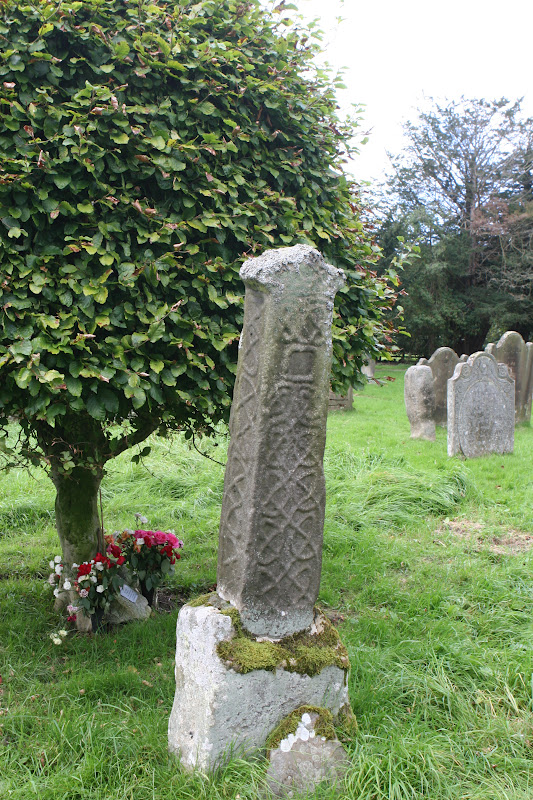
Anglo Danish Preaching Cross
St Oswald's Churchyard,  Hauxwell


The idea is that in an age when people didn't often go to church buildings, they gathered round sacred stones and stone or wooden preaching crosses to hear the gospel told, to pray and to talk. This was, in Saxon and slightly later times, because there weren't many church buildings to gather in and for fear of being attacked by an enemy. Today, people don't go into church buildings but for very different reasons, often to do with awe of the unfamiliarity of the building itself or because we simply tend to congregate more naturally in pubs and clubs and cafes and secular places. Saxon Roots begins with the idea of the preaching cross as a place were people come together to take God seriously. I quote from their website,

'The point is....if we gather round a preaching cross, we arrive from all sorts of directions. We come as we are to a special place, a place of symbols....we look at familiar things afresh and they seem different. And in that difference is a space; an imaginative space for us to allow God to speak to us in new ways.'

Standing crosses were used for many purposes; within a settlement they marked the spot for public proclamation, preaching, penance and sacramental rites, they indicated places of sanctuary, they marked boundaries and they commemorated battles. Often crosses were located in market places and some are connected to a particular saint whose protection the presence of the cross was believed to invoke. The cross pictured above is not in fact Saxon but dates from a slightly later period - the 10th or 11th century, a time when there was a degree of fusion between Anglian and Dane as invader and invaded came to acknowledge that they had a common Christian faith. It stands in St Oswald's churchyard in Wensleydale and is, for me, a profound symbol of the power of the Christian faith, against all odds, to draw together people of vastly different heritage and culture whose interests are sometimes diametrically opposed. One of the panels is possibly older than the rest of the cross and refers to St James the Deacon, a seventh century missionary. If you want to be more conscious of the Saxon heritage of the area, wander down the road to Thornton Steward, described here

I think Saxon Roots is on to something special. On 25th October, Ripon Cathedral, with its 672 Saxon crypt and a community that's worshipped ever since (not the same people, you'll understand!) is simply inviting us to come and help create a worship event. Bring yourself, as they say, be yourself, and prepare to meet others who are different. The worship will blend elements of traditional Christian worship with non-traditional elements. There will be time to do your own spiritual exploring with things to look at, to read, to think about, to discuss and to do. The evening will include 'ancient music', biblical meditations and a short talk. There will be time to pray and space to be either alone or with others. There is even talk of a digital preaching cross and bacon sandwiches! There are plans subsequently to take this event outside the cathedral into the villages of the area as well, in keeping with the project's inspiration.

To read more, go to


What has this to do with social justice and community development (the themes of this blog)? Well, it's all about bringing people together to a place of honesty where together we can acknowledge God and each other; it's all about difference meeting and joining up so that new understandings are created.

Thursday, 12 September 2013

Syria

I've hesitated to say anything about the situation in Syria when so much has been said by many who know a great deal more about the situation than I do. But I have been galvanised into writing today by the unusual situation of finding myself in complete agreement with Vladimir Putin. His warning that a U.S. military strike 'could increase violence and unleash a new wave of terrorism' is no less spot on for being obvious. Military action by the U.S. will further sabotage progress over the Iranian nuclear problem and the Israel/Palestine conflict. It will have a deeply unsettling effect on Lebanon, Jordan, Turkey, Iraq and the countries of Northern Africa who are receiving large numbers of Syrian refugees. Focusing a response on a strike against the use of chemical weapons is stupefyingly simplistic and short sighted and repeats the now often-made mistake of riding rough shod over the subtleties and complexities of internal Islamic and Middle Eastern political relationships. Putin warns the Obama regime in these terms, 

"Millions around the world increasingly see America not as a model of democracy but as relying solely on brute force, cobbling coalitions together under the slogan: 'You're either with us or against us.' Russia is not aiming to protect the Syrian government but international law."

By all means, hunt down those who are responsible for the use of chemical weapons and try them as war criminals. But a military strike will cause massive further suffering to the hundreds of thousands who are already suffering the effects of more conventional weapons. Scarcity of food and health care, loss of homes, incomes and employment and internal displacement or exile are the daily lot of most citizens. On-the-ground humanitarian organisations like CAFOD, Caritas Lebanon, Aid to the Church in Need are united in calling for aid, not military action. Damacus-based Greek Orthodox Patriarch Gregorios III (who himself narrowly missed being blown up by a bomb) has said that military action will be disastrous and that, despite the level of conflict, 'reconciliation initiatives are still viable' - indeed preferable.

In the House of Lords, Baroness Caroline Cox of HART here has drawn attention to the need for Syrians to find their own resolution without Western military interference so that the country does not lose its own inherent progress toward a balance of the interests of the many different political and religious groups. 

 'For many years, despite a despotic regime, Syria ensured freedoms for diverse faith traditions and for women which were enviable in comparison with its neighbours in the Middle East. There are real fears that any replacement regime, almost inevitably ruled or influenced by Islamists, will reduce Syria to the potentially irreversible destruction of religious freedoms and women’s rights. I therefore share the profound concerns about a military intervention that could unleash even more suffering. Bringing the perpetrators of crimes against humanity to justice must be the priority, not supporting, either directly or indirectly, militias that are also committing heinous and egregious violations.' (Hansard, Lords Debate 28th August.)

To help put this in a wider context, the Quaker peace talks in York, this autumn, will be providing a chance to go on thinking about the options for effective Western interaction and aid in the Middle east.  The first in the series is at the Bootham School 7pm on 

Tuesday 1st October: “Threats to Peace: events since 9/11 and what they mean for the future” with Paul Rogers, Professor in Peace Studies at Bradford University, editor of Open Democracy and consultant for the Oxford Research Group.