The idea of dementia as an asset sounds almost offensive but this was a suggestion that came out of a recent seminar hosted by the Guardian, in conjunction with the Joseph Rowntree Foundation, the British Red Cross, PA Consulting and Barchester Health Care. In fact, it's a call for us to rethink the whole way we understand dementia and even ageing itself. The idea? People with dementia and their families need friendly communities where care is reliably shared and respect for the human person, no matter how old or frail or confused or debilitated, is the touch stone. Dare we ask, could the drive to create such communities in fact be the key to a better life for us all?
It's this kind of radical thinking that is going to be essential in ensuring that we can look after the estimated 1.7 million of us who will be living with the disease by 2050. (Currently there are over 820,000 and my area of Yorkshire has a higher than average incidence.) An idea that came from the seminar took the model of what happens when you get pregnant. When the pregnancy is confirmed, in effect, you join a community. You usually receive a welcome pack, you have a midwife assigned to you and you attend groups that introduce you to other parents-to-be. This helps to support you through your pregnancy and there is good evidence that mothers who engage with all this have a lower incidence of birth complications. Dementia sufferers need a similar approach. At the point of diagnosis, they need information, time to discuss the implications, an assigned health worker who is going to ensure that there is some continuity of care as the disease progresses and a gradual introduction to a community of others who are facing a similar journey. Longer GP appointments which allow extra time in order to overcome communication barriers would be helpful in the case of anyone who has the disease. In addition, because of memory loss and the lack of facility to recognise people that often comes later in the disease, people with dementia need to see the same faces again and again and to be cared for by professionals who get to know them and their families in some depth. Pregnancy care is also a good model because it entails real co-operation between mother, family and professionals. This is something that is increasingly being eroded in health care as each branch becomes more and more professionalized and as the way we deal with important safeguarding issues drives a wedge between what can be offered professionally and what can be done voluntarily. For a happy life, a dementia sufferer needs to be surrounded by professionals, family and volunteers who communicate effectively with one another and, under controlled circumstances, share vital information.
I was recently talking to a taxi driver at the gym. She was telling me about how much of her work is now with the elderly, including several people who have dementia. She picks people up, helps them to remember where they are going and what they need to take with them, and often has to allow extra time to gently persuade them do even simple things like getting in and out of the car. She has several people whom she takes regularly to visit family or to day centres or for fish and chips(!) and these people would not get out at all if it were not for her care. This is all in a day's work and she doesn't have any special training but she knows that she is a key element in a support system that allows these individuals some dignity and enjoyment of life.
The Dementia Friends Initiative here and local initiatives such as, in my area of North Yorkshire (Ripon and Harrogate), Dementia Forward here are working to create a situation where there are one million people in the UK who are 'Dementia aware' by 2015. They are looking for people to befriend sufferers and their families and people who are willing to acquire sufficient understanding of the disease to become champions. One idea that has been put forward is that we designate 'dementia friendly towns' rather along the same lines as cities and towns of sanctuary which offer a particular welcome for asylum seekers. This would involve training people like bus and taxi drivers, shop assistants, bank clerks, housing facility managers and clergy to be aware of how they can be most helpful to the people with dementia they come across everyday as part of their job. It's not just health care professionals that need specific training.
Please, please take a moment to think about this and/or visit one of these sites. Could your locality work towards becoming a dementia friendly place, perhaps starting with your place of work or church?
One person in three is likely to develop some degree of dementia. Did you know that it is possible only 45% of people with dementia have been diagnosed in the UK? The NHS is aiming to get this up to 66% by 2015. Would we accept this figure for other diseases?
People with dementia make a big contribution to our lives. My music tutor was playing the piano well into the disease; I've only just put down a Terry Pratchett novel.... You can find further examples in the Alzheimer's Research UK Blog here
Janet Henderson writes on social justice, community development, theology and the future.
Thursday, 26 September 2013
Unemployment and Identity; A Meditation
'I'm not working,' elicits all sorts of responses from the kindly, 'Oh, but I'm sure you do work very hard,' to the quizzical look that says, 'Could she be over 60?...but I daren't ask.' If you are unwaged it seems you have to explain yourself in ways that you don't if you have a job. I've quite enjoyed the game of how to fill in the blank. It truthfully varies from, 'I'm in between jobs,' to 'I'm writing a book,' and 'I'm doing some teaching, yes, theology, no that's nothing to do with trees, it's about God,' or 'Well I used to be a nurse a long time ago.' Or sometimes, 'No I don't work and I don't know what the future holds.' You can range, at will, and according to mood, from the sublime heights of grand sounding projects to complete deflation and hopelessness. Any trace of depression has an interesting effect on people - they either back off very hurriedly or else wade in with suggestions of jobs and voluntary work you aren't remotely qualified to do, attributing to you skills you don't recognise.
Then there's the question of resources. Suddenly you are better resourced in terms of time than you have ever been, you have a different range of choices and you're much less well off in terms of petrol, money and office equipment. This means you can shape your life quite differently. At times, this feels like a wonderful opportunity; at others, it feels like a bleak imposition that cuts you off from the things you were used to. There's the joy of discovering colleagues are now friends and the sadness of losing contact with others suddenly and completely. I'm only too aware that, had I given up my job due to ill-health (which I didn't), I'd also be coming to terms with a change in body image, levels of disability and, possibly, expectations of longevity. We moved house so there was a dislocation in terms of friends, neighbours and familiar places.
There's also the whole thing about what to call yourself. That might seem relatively trivial but it leads to a lot of quite comical confusion. Since I don't use my husband's name professionally (the advice was, don't change your name or you lose all your publications and your professional continuity) I'm used to arriving at events and being unable to remember which surname I booked in with. I'm also used to not quite knowing whether to call myself Ms or Mrs when using my own name. I often take comfort in the words of the bank manager who looked hard at me and said, 'Madam you can have as many names as you like as long as you don't use any of them fraudulently.' But since stepping out of ministry temporarily I've discovered a new complication. Given the vast array of titles different sorts of clergy use, and given the kinds of roles I've had in the past, I now get addressed in at least six different ways. I don't mind, but it seems to cause other people embarrassment. Personally, I go with the Quaker option. 'Janet Henderson' will do nicely - we have names for a reason and Christians, especially, might as well use Christian names.
Anyone who's been made redundant, resigned suddenly from a job, retired or given up 'work' to have a baby or look after a relative will know exactly what I'm talking about. It can be a shock. You can view it all as a glorious opportunity but it inevitably brings with it an element of bereavement and may well tip you into depression, loss of self-worth or apathy. 'Not working' in our society is a place of great liminality, neither one thing nor another, since, patently, everyone works to keep themselves (and others) going whether they are paid and recognised for it or not. The sense of liminality is increased if you don't know how long the state is likely to last. If you're actively planning a return to work, you can find yourself on a roller-coaster of eager anticipation and dashed hopes, making it difficult to settle down and probably making you difficult to live with for those around who are trying to get on with their lives and lend some stability to the situation.
All this inevitably leads you to the existential question, 'Who am I?' Who am I now that this has changed or that has gone? Who am I now that people react to me differently or don't react? Who am I now that my role has gone? I guess for clergy this can be particularly poignant as we generally continue to attend and be part of church even though our role has changed.
God sees who we are without all this paraphernalia. Since when did God identify us by the work we do or the role we play? God generally calls people for some mysterious reason best known to God and often for a quality God alone sees in them. Abram has faith, Isaiah is ready to confess his sins, Moses is not identified as coming from a royal background and therefore being fitted for leadership, but as someone who is a bit tongue-tied and not very articulate. Hagar is an outcast with no pretensions. Even the fisher-disciples are told that their understanding of fishing is going to be re-configured. Jesus saw in Peter a rock (not a church leader) and in James and John, the sons of thunder, fire (not a church leader and a theologian.)
"Who am I?' This is the question of those who feel themselves stripped of role or possessions or title or reputation or home or health and it is a profoundly God-ward question. It's the question that is met by the God who proclaims, or more likely whispers, 'I am who I am.' God doesn't define or reveal God's self through status or role or anything you can see or possess. The lesson of spiritual maturity is surely that God meets us most profoundly when we are stripped down and vulnerable just as Christ was stripped naked and vulnerable in the incarnation. And where God meets us, we are released into God's freedom, no longer held captive by society's categories of meaning.
"Who am I?'
'My child, you are the one who will go for me.'
Then there's the question of resources. Suddenly you are better resourced in terms of time than you have ever been, you have a different range of choices and you're much less well off in terms of petrol, money and office equipment. This means you can shape your life quite differently. At times, this feels like a wonderful opportunity; at others, it feels like a bleak imposition that cuts you off from the things you were used to. There's the joy of discovering colleagues are now friends and the sadness of losing contact with others suddenly and completely. I'm only too aware that, had I given up my job due to ill-health (which I didn't), I'd also be coming to terms with a change in body image, levels of disability and, possibly, expectations of longevity. We moved house so there was a dislocation in terms of friends, neighbours and familiar places.
There's also the whole thing about what to call yourself. That might seem relatively trivial but it leads to a lot of quite comical confusion. Since I don't use my husband's name professionally (the advice was, don't change your name or you lose all your publications and your professional continuity) I'm used to arriving at events and being unable to remember which surname I booked in with. I'm also used to not quite knowing whether to call myself Ms or Mrs when using my own name. I often take comfort in the words of the bank manager who looked hard at me and said, 'Madam you can have as many names as you like as long as you don't use any of them fraudulently.' But since stepping out of ministry temporarily I've discovered a new complication. Given the vast array of titles different sorts of clergy use, and given the kinds of roles I've had in the past, I now get addressed in at least six different ways. I don't mind, but it seems to cause other people embarrassment. Personally, I go with the Quaker option. 'Janet Henderson' will do nicely - we have names for a reason and Christians, especially, might as well use Christian names.
Anyone who's been made redundant, resigned suddenly from a job, retired or given up 'work' to have a baby or look after a relative will know exactly what I'm talking about. It can be a shock. You can view it all as a glorious opportunity but it inevitably brings with it an element of bereavement and may well tip you into depression, loss of self-worth or apathy. 'Not working' in our society is a place of great liminality, neither one thing nor another, since, patently, everyone works to keep themselves (and others) going whether they are paid and recognised for it or not. The sense of liminality is increased if you don't know how long the state is likely to last. If you're actively planning a return to work, you can find yourself on a roller-coaster of eager anticipation and dashed hopes, making it difficult to settle down and probably making you difficult to live with for those around who are trying to get on with their lives and lend some stability to the situation.
All this inevitably leads you to the existential question, 'Who am I?' Who am I now that this has changed or that has gone? Who am I now that people react to me differently or don't react? Who am I now that my role has gone? I guess for clergy this can be particularly poignant as we generally continue to attend and be part of church even though our role has changed.
God sees who we are without all this paraphernalia. Since when did God identify us by the work we do or the role we play? God generally calls people for some mysterious reason best known to God and often for a quality God alone sees in them. Abram has faith, Isaiah is ready to confess his sins, Moses is not identified as coming from a royal background and therefore being fitted for leadership, but as someone who is a bit tongue-tied and not very articulate. Hagar is an outcast with no pretensions. Even the fisher-disciples are told that their understanding of fishing is going to be re-configured. Jesus saw in Peter a rock (not a church leader) and in James and John, the sons of thunder, fire (not a church leader and a theologian.)
"Who am I?' This is the question of those who feel themselves stripped of role or possessions or title or reputation or home or health and it is a profoundly God-ward question. It's the question that is met by the God who proclaims, or more likely whispers, 'I am who I am.' God doesn't define or reveal God's self through status or role or anything you can see or possess. The lesson of spiritual maturity is surely that God meets us most profoundly when we are stripped down and vulnerable just as Christ was stripped naked and vulnerable in the incarnation. And where God meets us, we are released into God's freedom, no longer held captive by society's categories of meaning.
"Who am I?'
'My child, you are the one who will go for me.'
Monday, 16 September 2013
The Gift of Language;
Y Rhodd O Iaith
ο δώρο της γλώσσας
One of the great delights of social media is its potential for getting us to use more languages and to use them interchangeably. A member of our family has recently moved to Greece and I enjoy using my limited knowledge of classical Greek to try and decipher some of the things she posts. I've also recently discovered several Welsh speakers lurking in the English shadows - I had no idea the Vicar of Pateley Bridge (just up t'road from us in Nidderdale) spoke Welsh until it became clear through a chance Face Book exchange that we both had roots in North Wales. We've since been using Welsh and this is great for our fluency since neither of us has the chance to use it regularly.
Back in the 1970's there were some good French Canadian studies which showed that speaking more than one language helped children considerably with their cognitive development. This is particularly significant if they become bi-literate as well as bilingual.Why is it that the English are so wedded to monolingualism? I read a Guardian article today by Josephine Livingstone, The Case for Language Learning here. Livingstone says 'for many reasons, commercial, diplomatic, intellectual, we need to wake up to the reality that monolingualism is bad for us.' Her article is actually about the value of learning a dead language. I studied classics for A level and did ancient Hebrew as part of a degree so I wouldn't argue with that. But I'm even keener on the value of exploring the living languages that are all around us.
Almost all of us are likely to have been in a room, on a bus or a train or shared some space today with at least one person who was thinking in a language other than English. For some of us, that person was ourselves. We may not have realised it. You can't tell what language another person is thinking in and, if you are bilingual, you may not be immediately conscious of which language you yourself are thinking or even speaking in. Punjabi, Welsh, Urdu, Polish, Cantonese, Irish, Spanish, Hausa, French, Yoruba - I've heard all these spoken by people living in the part of North Yorkshire where we live. Yet it is common to find people regarding this as a threat rather than an opportunity.
What are the intrinsic benefits of bi- or multilingualism?
I attended a school where half the day was conducted in English and half in Welsh. I've always been so grateful to have had easy access to the literature of two cultures and the thought processes of two languages. I've also benefitted from that very non-English thing (it happens all over mainland Europe and Africa) of being quite happy to be part of a conversation where I might not understand every word, but I get the gist and can contribute. I've benefitted from early insight that, because things are expressed differently in different languages, the world can look quite radically different to people who are not of the same culture. Language, to a large degree, defines possibility. Speaking more than one widens the possibilities. For example, speaking two languages, one where gender is expressed in terms of masculine and feminine and the other where gender is expressed as masculine, feminine and neuter, poses questions about the philosophical and psychological categorisation of gender which I suppose I might not have asked, certainly not so soon, had I spoken only one language. In poetry, the common patterns of word order in a language have a huge effect on what's possible in terms of the juxtaposition of images and ideas, alliteration, rhythm and emphasis.
In one of the schools I regularly visited in Nottingham, 28 languages were spoken. The diversity of languages was a huge challenge for the staff. This is, in microcosm, the problem for English-only speakers. No one can learn 28 languages so which ones do you concentrate on? Well, I think the dawn of social media has made it much easier for us to cultivate a consistent interest in one or two languages. Simply to discipline yourself to read one article a day in another language will increase not only your linguistic ability but your cognitive agility immensely.
ο δώρο της γλώσσας
One of the great delights of social media is its potential for getting us to use more languages and to use them interchangeably. A member of our family has recently moved to Greece and I enjoy using my limited knowledge of classical Greek to try and decipher some of the things she posts. I've also recently discovered several Welsh speakers lurking in the English shadows - I had no idea the Vicar of Pateley Bridge (just up t'road from us in Nidderdale) spoke Welsh until it became clear through a chance Face Book exchange that we both had roots in North Wales. We've since been using Welsh and this is great for our fluency since neither of us has the chance to use it regularly.
Back in the 1970's there were some good French Canadian studies which showed that speaking more than one language helped children considerably with their cognitive development. This is particularly significant if they become bi-literate as well as bilingual.Why is it that the English are so wedded to monolingualism? I read a Guardian article today by Josephine Livingstone, The Case for Language Learning here. Livingstone says 'for many reasons, commercial, diplomatic, intellectual, we need to wake up to the reality that monolingualism is bad for us.' Her article is actually about the value of learning a dead language. I studied classics for A level and did ancient Hebrew as part of a degree so I wouldn't argue with that. But I'm even keener on the value of exploring the living languages that are all around us.
Almost all of us are likely to have been in a room, on a bus or a train or shared some space today with at least one person who was thinking in a language other than English. For some of us, that person was ourselves. We may not have realised it. You can't tell what language another person is thinking in and, if you are bilingual, you may not be immediately conscious of which language you yourself are thinking or even speaking in. Punjabi, Welsh, Urdu, Polish, Cantonese, Irish, Spanish, Hausa, French, Yoruba - I've heard all these spoken by people living in the part of North Yorkshire where we live. Yet it is common to find people regarding this as a threat rather than an opportunity.
What are the intrinsic benefits of bi- or multilingualism?
I attended a school where half the day was conducted in English and half in Welsh. I've always been so grateful to have had easy access to the literature of two cultures and the thought processes of two languages. I've also benefitted from that very non-English thing (it happens all over mainland Europe and Africa) of being quite happy to be part of a conversation where I might not understand every word, but I get the gist and can contribute. I've benefitted from early insight that, because things are expressed differently in different languages, the world can look quite radically different to people who are not of the same culture. Language, to a large degree, defines possibility. Speaking more than one widens the possibilities. For example, speaking two languages, one where gender is expressed in terms of masculine and feminine and the other where gender is expressed as masculine, feminine and neuter, poses questions about the philosophical and psychological categorisation of gender which I suppose I might not have asked, certainly not so soon, had I spoken only one language. In poetry, the common patterns of word order in a language have a huge effect on what's possible in terms of the juxtaposition of images and ideas, alliteration, rhythm and emphasis.
In one of the schools I regularly visited in Nottingham, 28 languages were spoken. The diversity of languages was a huge challenge for the staff. This is, in microcosm, the problem for English-only speakers. No one can learn 28 languages so which ones do you concentrate on? Well, I think the dawn of social media has made it much easier for us to cultivate a consistent interest in one or two languages. Simply to discipline yourself to read one article a day in another language will increase not only your linguistic ability but your cognitive agility immensely.
Saturday, 14 September 2013
Community the Post-Saxon Way
Ripon cathedral is hosting a really exciting new project. I think it's exciting because it's not one of those schemes that arrives well formed, telling you exactly what it's about and how it's going to happen....and therein lies its pulling power. It's called Saxon Roots.
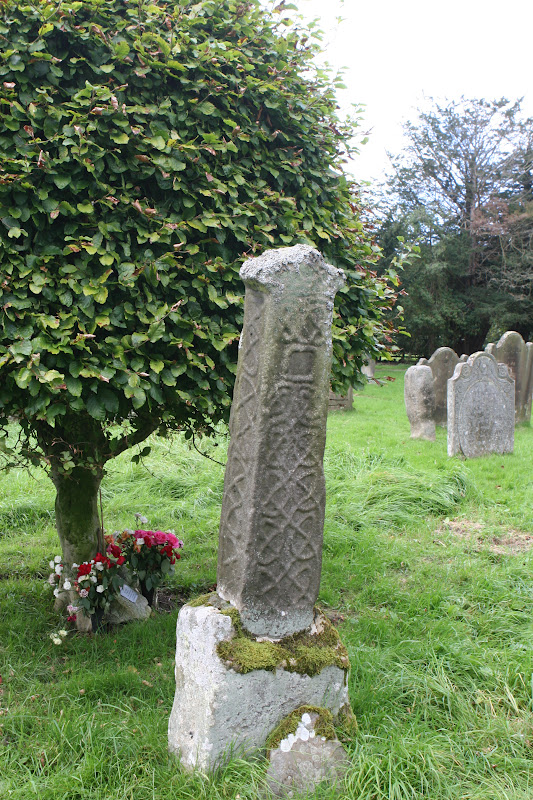
The seed which germinated the project is the preaching cross.
I think Saxon Roots is on to something special. On 25th October, Ripon Cathedral, with its 672 Saxon crypt and a community that's worshipped ever since (not the same people, you'll understand!) is simply inviting us to come and help create a worship event. Bring yourself, as they say, be yourself, and prepare to meet others who are different. The worship will blend elements of traditional Christian worship with non-traditional elements. There will be time to do your own spiritual exploring with things to look at, to read, to think about, to discuss and to do. The evening will include 'ancient music', biblical meditations and a short talk. There will be time to pray and space to be either alone or with others. There is even talk of a digital preaching cross and bacon sandwiches! There are plans subsequently to take this event outside the cathedral into the villages of the area as well, in keeping with the project's inspiration.
The seed which germinated the project is the preaching cross.
![]() |
| Anglo Danish Preaching Cross St Oswald's Churchyard, Hauxwell |
The idea is that in an age when people didn't often go to church buildings, they gathered round sacred stones and stone or wooden preaching crosses to hear the gospel told, to pray and to talk. This was, in Saxon and slightly later times, because there weren't many church buildings to gather in and for fear of being attacked by an enemy. Today, people don't go into church buildings but for very different reasons, often to do with awe of the unfamiliarity of the building itself or because we simply tend to congregate more naturally in pubs and clubs and cafes and secular places. Saxon Roots begins with the idea of the preaching cross as a place were people come together to take God seriously. I quote from their website,
'The point is....if we gather round a preaching cross, we arrive from all sorts of directions. We come as we are to a special place, a place of symbols....we look at familiar things afresh and they seem different. And in that difference is a space; an imaginative space for us to allow God to speak to us in new ways.'
Standing crosses were used for many purposes; within a settlement they marked the spot for public proclamation, preaching, penance and sacramental rites, they indicated places of sanctuary, they marked boundaries and they commemorated battles. Often crosses were located in market places and some are connected to a particular saint whose protection the presence of the cross was believed to invoke. The cross pictured above is not in fact Saxon but dates from a slightly later period - the 10th or 11th century, a time when there was a degree of fusion between Anglian and Dane as invader and invaded came to acknowledge that they had a common Christian faith. It stands in St Oswald's churchyard in Wensleydale and is, for me, a profound symbol of the power of the Christian faith, against all odds, to draw together people of vastly different heritage and culture whose interests are sometimes diametrically opposed. One of the panels is possibly older than the rest of the cross and refers to St James the Deacon, a seventh century missionary. If you want to be more conscious of the Saxon heritage of the area, wander down the road to Thornton Steward, described here
To read more, go to
What has this to do with social justice and community development (the themes of this blog)? Well, it's all about bringing people together to a place of honesty where together we can acknowledge God and each other; it's all about difference meeting and joining up so that new understandings are created.
Thursday, 12 September 2013
Syria
I've hesitated to say anything about the situation in Syria when so much has been said by many who know a great deal more about the situation than I do. But I have been galvanised into writing today by the unusual situation of finding myself in complete agreement with Vladimir Putin. His warning that a U.S. military strike 'could increase violence and unleash a new wave of terrorism' is no less spot on for being obvious. Military action by the U.S. will further sabotage progress over the Iranian nuclear problem and the Israel/Palestine conflict. It will have a deeply unsettling effect on Lebanon, Jordan, Turkey, Iraq and the countries of Northern Africa who are receiving large numbers of Syrian refugees. Focusing a response on a strike against the use of chemical weapons is stupefyingly simplistic and short sighted and repeats the now often-made mistake of riding rough shod over the subtleties and complexities of internal Islamic and Middle Eastern political relationships. Putin warns the Obama regime in these terms,
"Millions around the world increasingly see America not as a model of democracy but as relying solely on brute force, cobbling coalitions together under the slogan: 'You're either with us or against us.' Russia is not aiming to protect the Syrian government but international law."
By all means, hunt down those who are responsible for the use of chemical weapons and try them as war criminals. But a military strike will cause massive further suffering to the hundreds of thousands who are already suffering the effects of more conventional weapons. Scarcity of food and health care, loss of homes, incomes and employment and internal displacement or exile are the daily lot of most citizens. On-the-ground humanitarian organisations like CAFOD, Caritas Lebanon, Aid to the Church in Need are united in calling for aid, not military action. Damacus-based Greek Orthodox Patriarch Gregorios III (who himself narrowly missed being blown up by a bomb) has said that military action will be disastrous and that, despite the level of conflict, 'reconciliation initiatives are still viable' - indeed preferable.
In the House of Lords, Baroness Caroline Cox of HART here has drawn attention to the need for Syrians to find their own resolution without Western military interference so that the country does not lose its own inherent progress toward a balance of the interests of the many different political and religious groups.
'For many years, despite a despotic regime, Syria ensured freedoms for diverse faith traditions and for women which were enviable in comparison with its neighbours in the Middle East. There are real fears that any replacement regime, almost inevitably ruled or influenced by Islamists, will reduce Syria to the potentially irreversible destruction of religious freedoms and women’s rights. I therefore share the profound concerns about a military intervention that could unleash even more suffering. Bringing the perpetrators of crimes against humanity to justice must be the priority, not supporting, either directly or indirectly, militias that are also committing heinous and egregious violations.' (Hansard, Lords Debate 28th August.)
To help put this in a wider context, the Quaker peace talks in York, this autumn, will be providing a chance to go on thinking about the options for effective Western interaction and aid in the Middle east. The first in the series is at the Bootham School 7pm on
Tuesday 1st October: “Threats to Peace: events since 9/11 and what they mean for the future” with Paul Rogers, Professor in Peace Studies at Bradford University, editor of Open Democracy and consultant for the Oxford Research Group.
"Millions around the world increasingly see America not as a model of democracy but as relying solely on brute force, cobbling coalitions together under the slogan: 'You're either with us or against us.' Russia is not aiming to protect the Syrian government but international law."
By all means, hunt down those who are responsible for the use of chemical weapons and try them as war criminals. But a military strike will cause massive further suffering to the hundreds of thousands who are already suffering the effects of more conventional weapons. Scarcity of food and health care, loss of homes, incomes and employment and internal displacement or exile are the daily lot of most citizens. On-the-ground humanitarian organisations like CAFOD, Caritas Lebanon, Aid to the Church in Need are united in calling for aid, not military action. Damacus-based Greek Orthodox Patriarch Gregorios III (who himself narrowly missed being blown up by a bomb) has said that military action will be disastrous and that, despite the level of conflict, 'reconciliation initiatives are still viable' - indeed preferable.
In the House of Lords, Baroness Caroline Cox of HART here has drawn attention to the need for Syrians to find their own resolution without Western military interference so that the country does not lose its own inherent progress toward a balance of the interests of the many different political and religious groups.
'For many years, despite a despotic regime, Syria ensured freedoms for diverse faith traditions and for women which were enviable in comparison with its neighbours in the Middle East. There are real fears that any replacement regime, almost inevitably ruled or influenced by Islamists, will reduce Syria to the potentially irreversible destruction of religious freedoms and women’s rights. I therefore share the profound concerns about a military intervention that could unleash even more suffering. Bringing the perpetrators of crimes against humanity to justice must be the priority, not supporting, either directly or indirectly, militias that are also committing heinous and egregious violations.' (Hansard, Lords Debate 28th August.)
To help put this in a wider context, the Quaker peace talks in York, this autumn, will be providing a chance to go on thinking about the options for effective Western interaction and aid in the Middle east. The first in the series is at the Bootham School 7pm on
Tuesday 1st October: “Threats to Peace: events since 9/11 and what they mean for the future” with Paul Rogers, Professor in Peace Studies at Bradford University, editor of Open Democracy and consultant for the Oxford Research Group.
Sunday, 25 August 2013
Communities of Memory; Life with Dementia
I've been reading John Swinton's book Dementia; Living in the Memories of God (Eerdmans and SCM 2012) here. As Stanley Hauerwas says, Swinton is a premier pastoral theologian and his writings generally break new ground. In this, his latest book, he challenges as too limited current medical models for understanding dementia. What I particularly like is the way that he demonstrates how essential our thinking about what community is in shaping holistic approaches to this frightening disease. Having made the theological case for understanding that every person exists in the memory of God and is held there for all eternity, he goes on to describe the church as a 'living body of remembering friends' and says that we must 'create the types of relationships and communities that will allow us to....remember with a love that drives us into the presence of people with dementia.'
This is a major challenge to the churches and also to the way that we think about dementia and care for its sufferers as a society. Lovely as the sentiments in the book sound, I find myself wondering how effectively churches serve those who have attended for years but disappear as dementia takes hold. There is a natural fear which comes from really not understanding the disease and not feeling competent to communicate - the embarrassment when, on a Sunday morning Harry suddenly fails to recognise old friends and Betty begins to wander around during the service, interjecting with unintelligible, distressed-sounding exclamations. The monthly visit of the clergy or pastoral assistant to local nursing homes, though important in using the things like music, ritual and story that Swinton talks about, hardly seems adequate. I find myself wondering, too, how and if the NHS and social care agencies will ever be equal to the task of supporting and nursing the rising numbers of dementia sufferers. How can they do this in a society where the nuclear family is still, at least notionally, the basis of social structure? Even where people are living in or near families (and many are not) it is difficult for care givers to divide their energy between care for older family members, children and work without undermining their own strength to carry out the kind of 24 hour care, seven days a week that is required. Loneliness and isolation often overtake the care givers as much as the patient.
Swinton's book is a huge challenge to our whole way of thinking about community. It forces us to think about how to generate sustained support across larger groups than the nuclear family. Just as mothers and fathers have usually formed support networks to care for the needs of very young children, so each of us, as we enter our final decades of life, will need to give attention to forming around us a community of care, knowing that some of us may need to receive more and others may give more; as with the care of children who all have different needs, this will not be a community of equally-weighted caring and this is why Swinton's starting point is so important - we are all, as we are and as we shall become, held as children of God, eternally precious. In the Kingdom of God, apparent givers become receivers and vice versa and, in fact, such distinctions and ways of thinking begin to break down.
Swinton's book is also a huge challenge to action. One of the things that people with dementia most need is time - every activity takes a great deal more time than normal, relies on the creation of mood and a good 'emotional temperature', and succeeds best where the care giver has had enough time over weeks and months to become familiar with and to the sufferer. This kind of care demands that much larger numbers of people get involved than is currently the case and that they stay committed, giving the months or years needed to remain involved with an individual and to see them through the different stages of their illness. In our transient society where so many of us are on the move so often and where everyone is 'pressed for time', the kind of environment that is needed by people with dementia is simply impossible to create and sustain without some kind of Copernican revolution in our values and ways of structuring life. A complete rethink is needed in what we value and how we show we value it. We need to provide training for volunteers and to pay those who work with dementia sufferers properly. Theirs is among the most demanding jobs I know, yet is is often done for very poor remuneration by people with little training and pitifully few resources. There is almost always a sense in nursing homes and day centres that more staff are needed and yet pressure to hurry is one of the most harmful things for those who are struggling with loss of memory, understanding and ability to do everyday tasks such as dressing and eating.
Just as the hospice movement has (with not complete success) influenced the way the whole health service thinks about terminal care, we need a fresh movement that generates new models of care for those whose memories and personalities fragment as they progress through the stages of dementia, often also suffering from other conditions which may or may not be recognised and treated. Can the churches help by beginning to explore ways for people who inhabit forgetfulness to be located in communities where they truly are not forgotten and where their continuity and memory is 'held' for them in practical as well as existential ways on a daily basis for as long as they live?
For further information and sources of support see The Alzheimer's Society here
This is a major challenge to the churches and also to the way that we think about dementia and care for its sufferers as a society. Lovely as the sentiments in the book sound, I find myself wondering how effectively churches serve those who have attended for years but disappear as dementia takes hold. There is a natural fear which comes from really not understanding the disease and not feeling competent to communicate - the embarrassment when, on a Sunday morning Harry suddenly fails to recognise old friends and Betty begins to wander around during the service, interjecting with unintelligible, distressed-sounding exclamations. The monthly visit of the clergy or pastoral assistant to local nursing homes, though important in using the things like music, ritual and story that Swinton talks about, hardly seems adequate. I find myself wondering, too, how and if the NHS and social care agencies will ever be equal to the task of supporting and nursing the rising numbers of dementia sufferers. How can they do this in a society where the nuclear family is still, at least notionally, the basis of social structure? Even where people are living in or near families (and many are not) it is difficult for care givers to divide their energy between care for older family members, children and work without undermining their own strength to carry out the kind of 24 hour care, seven days a week that is required. Loneliness and isolation often overtake the care givers as much as the patient.
![]() |
| SCM Press here |
Swinton's book is a huge challenge to our whole way of thinking about community. It forces us to think about how to generate sustained support across larger groups than the nuclear family. Just as mothers and fathers have usually formed support networks to care for the needs of very young children, so each of us, as we enter our final decades of life, will need to give attention to forming around us a community of care, knowing that some of us may need to receive more and others may give more; as with the care of children who all have different needs, this will not be a community of equally-weighted caring and this is why Swinton's starting point is so important - we are all, as we are and as we shall become, held as children of God, eternally precious. In the Kingdom of God, apparent givers become receivers and vice versa and, in fact, such distinctions and ways of thinking begin to break down.
Swinton's book is also a huge challenge to action. One of the things that people with dementia most need is time - every activity takes a great deal more time than normal, relies on the creation of mood and a good 'emotional temperature', and succeeds best where the care giver has had enough time over weeks and months to become familiar with and to the sufferer. This kind of care demands that much larger numbers of people get involved than is currently the case and that they stay committed, giving the months or years needed to remain involved with an individual and to see them through the different stages of their illness. In our transient society where so many of us are on the move so often and where everyone is 'pressed for time', the kind of environment that is needed by people with dementia is simply impossible to create and sustain without some kind of Copernican revolution in our values and ways of structuring life. A complete rethink is needed in what we value and how we show we value it. We need to provide training for volunteers and to pay those who work with dementia sufferers properly. Theirs is among the most demanding jobs I know, yet is is often done for very poor remuneration by people with little training and pitifully few resources. There is almost always a sense in nursing homes and day centres that more staff are needed and yet pressure to hurry is one of the most harmful things for those who are struggling with loss of memory, understanding and ability to do everyday tasks such as dressing and eating.
Just as the hospice movement has (with not complete success) influenced the way the whole health service thinks about terminal care, we need a fresh movement that generates new models of care for those whose memories and personalities fragment as they progress through the stages of dementia, often also suffering from other conditions which may or may not be recognised and treated. Can the churches help by beginning to explore ways for people who inhabit forgetfulness to be located in communities where they truly are not forgotten and where their continuity and memory is 'held' for them in practical as well as existential ways on a daily basis for as long as they live?
For further information and sources of support see The Alzheimer's Society here
Saturday, 17 August 2013
Grow Up or Grow Wise?
At one level it would be impossible to disagree with Rowan Williams when he says that Christians in the USA and Britain who claim that they are persecuted should 'grow up'. It 's almost obscene to think the kinds of danger with which Christians in places like Syria, Iran and Egypt live have anything at all to do with the mild feeling of being ignored, ridiculed or disapproved that Christians in the UK sometimes experience. Of course.
The effects of the kinds of persecution Williams is thinking about don't just destroy life while they last. I met members of the Silent Church in the Czech Republic who had been imprisoned with hard labour during the 1950's. They witnessed many of their friends' deaths and if they were lucky enough to get out of prison, some had been tortured all over again in different ways in the 1970's when a fresh round of infiltration and persecution of Christians began. Their whole adult lives, almost, had been taken up with surviving persecution and their old age was dominated by memories of living with that and losing many of their comrades. Even at the end of their lives, their suffering continued because these experiences drove a wedge between their understanding of what it is to be a Christian and the vision of new young Christians, post the end of Communism. This was a further source of pain. Was there no getting away from this endless cycle of sorrow? Only an incredible, profound belief in the resurrection power of Christ could sustain them through all this. In the presence of such a belief one did, as Williams says, feel utterly humbled and chastened. Williams is right; there is nothing in the recent history of British Christianity that compares with this kind of experience, even remotely.
But I can't get away from the fact I feel an unease at William's remark. There's something here about ranking suffering, isn't there? And that can be very dangerous because it lets us off the hook as far as doing much about the sources of injustice and oppression that do occur in our own contexts in the UK. Just as we would not say to a victim of abuse, 'your abuse wasn't as bad as someone else's,' we ought to listen and take very seriously stories about the harm that comes of injustice and oppression in our own society. It seems from the context of William's words (an interview at the Edinburgh Festival with Rabbi Julia Neuberger here) that he was thinking about Western Christians who complain they are ostracised because of their beliefs or practices. I guess this means Christians feeling marginalised and attacked in a secular workplace or it could mean Christian homosexuals, lesbians, women or traditionalists who feel 'got at' because they are unacceptable in certain circles. However, some of the forces at work in such circumstances are the very same forces that we see in an infinitely stronger form in communities where unacceptability or difference is punished by violence. I am uncomfortable with Williams' remark (as it was reported) because it seems to introduce a kind of dualism where it does not belong. To take an example, women like Malala Yousafzai UN speech here, who are shot or beaten for attempting to engage in education suffer an extreme form of violence because of attitudes to female worth - but this is connected to attitudes that mark women out as second class in every society. It's no good saying that because of the degree of suffering inflicted the one has nothing to do with the other. The way to address this particular injustice, I think, is to listen and learn and to look to one another for support and solidarity across cultures. There are, I believe, common themes at play as there would also be in the cases of homophobia, prostitution, coercion of children or sectarian violence.
We can be guilty of down-playing the injustice and abuses that go on in our own communities. This is especially so if we ourselves are in the 'comfortable majority' or the position with most of the power. It's also especially so if we see the injustices around us as 'relatively mild' and so let them pass and even despise those who try to voice the problems. To dismiss the voices of those who 'make a fuss' as childish winging is to miss the point though it is, of course, taxing to take apparently smaller forms of oppression seriously when, like the former archbishop, you are in a position to witness great wrongs which sear the heart and mind.
The effects of the kinds of persecution Williams is thinking about don't just destroy life while they last. I met members of the Silent Church in the Czech Republic who had been imprisoned with hard labour during the 1950's. They witnessed many of their friends' deaths and if they were lucky enough to get out of prison, some had been tortured all over again in different ways in the 1970's when a fresh round of infiltration and persecution of Christians began. Their whole adult lives, almost, had been taken up with surviving persecution and their old age was dominated by memories of living with that and losing many of their comrades. Even at the end of their lives, their suffering continued because these experiences drove a wedge between their understanding of what it is to be a Christian and the vision of new young Christians, post the end of Communism. This was a further source of pain. Was there no getting away from this endless cycle of sorrow? Only an incredible, profound belief in the resurrection power of Christ could sustain them through all this. In the presence of such a belief one did, as Williams says, feel utterly humbled and chastened. Williams is right; there is nothing in the recent history of British Christianity that compares with this kind of experience, even remotely.
But I can't get away from the fact I feel an unease at William's remark. There's something here about ranking suffering, isn't there? And that can be very dangerous because it lets us off the hook as far as doing much about the sources of injustice and oppression that do occur in our own contexts in the UK. Just as we would not say to a victim of abuse, 'your abuse wasn't as bad as someone else's,' we ought to listen and take very seriously stories about the harm that comes of injustice and oppression in our own society. It seems from the context of William's words (an interview at the Edinburgh Festival with Rabbi Julia Neuberger here) that he was thinking about Western Christians who complain they are ostracised because of their beliefs or practices. I guess this means Christians feeling marginalised and attacked in a secular workplace or it could mean Christian homosexuals, lesbians, women or traditionalists who feel 'got at' because they are unacceptable in certain circles. However, some of the forces at work in such circumstances are the very same forces that we see in an infinitely stronger form in communities where unacceptability or difference is punished by violence. I am uncomfortable with Williams' remark (as it was reported) because it seems to introduce a kind of dualism where it does not belong. To take an example, women like Malala Yousafzai UN speech here, who are shot or beaten for attempting to engage in education suffer an extreme form of violence because of attitudes to female worth - but this is connected to attitudes that mark women out as second class in every society. It's no good saying that because of the degree of suffering inflicted the one has nothing to do with the other. The way to address this particular injustice, I think, is to listen and learn and to look to one another for support and solidarity across cultures. There are, I believe, common themes at play as there would also be in the cases of homophobia, prostitution, coercion of children or sectarian violence.
![]() |
| Malala Yousefzia www.nepalnews.com |
Thursday, 15 August 2013
Trees for Life
'The best time to plant a tree is twenty years ago. The second best time is now.'
![]() |
| www.treeaid.org.uk |
There is a charity called TREE AID here that works to bring life, through trees, to families in rural Africa. When trees disappear because of drought or exploitation, this is usually followed by soil erosion, crop failure and the ensuing displacement of communities. TREE AID helps villagers in Mali, Ghana, Burkina Faso and Ethiopia make the best use of trees to generate food, housing, fuel, medicine and income for health care and schooling. The wonderful thing about trees is that they are infinitely flexible in the uses to which it can be put. Since 1987 TREE AID has helped 300,000 people plant 6.5 million trees which provide an alternative to both poverty and environmental destruction. Take an example - the fruit of the Shea tree can be used to produce shea butter which is used as a cooking oil, for candle making and as a waterproof waxing on cloth or wood. It also has medicinal properties and can be used on burns, eczema and as a sun block. We might know it better as Yoruba which is used in a lot of cosmetics. One tree can bring nutrition, business and healing to a community.An arboretum is a wonderful place in which to meditate on the wisdom, balance and healing power found in the natural world and there for the use of us all. In the Anglican communion, the fifth mark of mission is commitment 'to strive to safeguard the integrity of creation and sustain and renew the life of the earth.' Supporting the planting of trees is one way to make this more than wishful thinking.
Wednesday, 14 August 2013
Media Processes
There's been a lot of talk about the use of social media to bully in the last few days. Famously, Vicky Beeching and Caroline Criado-Perez have received threats and comments that are well beyond the limits of acceptability here (examples of the offending comments are at the bottom of the article.) There was a young woman on Woman's Hour today talking about how she had been cyber-bullied by other girls to the point of becoming suicidal. To my way of thinking, there is a connected problem in the press. Media articles sometimes distort and bully. To quote the award-winning journalist Nick Davies 'Our media has become mass producers of distortion' here and often this is targeted against individuals in a personal way.
Inaccurate reporting of the kind that gives rise to defamatory headlines was, at one time, something the victim of libel could at least dismiss as 'tomorrow's chip paper'. Untrue stories would die down and only the keen researcher would be likely to dig them up. Now, however, anything published by a journalist remains out there for good and can be picked up and go viral across the internet. Readers on every continent can see what has been written and have no way of knowing whether or not it represents the facts of the matter. Headlines that reduce complex matters to single phrases can give a completely false impression. For example, two comments from different perspectives can become a 'dispute', an individual's comment can be used to represent a whole group and an unhappy face can be used to portray anger. How can damaged - often undeservedly damaged - reputations be rebuilt? All this can happen almost in the twinkling of an eye. One of the things that contributes to the bullying aspect of media coverage is that those who are unlucky enough to find themselves misrepresented are often too nervous of further adverse publicity to try to put their side of the story or to complain.
How much do you believe of what you read in the press? If you're like me, you probably read an article and think, 'well, there must be a grain of truth somewhere in this.' You possibly trust some companies and newspapers more than others. Yet Nick Davies gives one example of what can happen. In 2005 a five year old boy was reported as having been hanged from a tree. In fact he had not, but the press then printed subsequent articles repeating the story and claiming that, as a result, fear was stalking the estate where he lived. You can image the effect on his family and on community relationships.
In his book Flat Earth News, Chatto and Windus, 2008, Nick Davies draws attention to the moral bankruptcy of parts of the British press. (He's pretty even handed in criticising across the board.) When the book was published, he claimed that, due to changes in the culture in which they work, journalists had too much space to fill and no time to put proper checks in place. With further staffing cuts the situation has undoubtedly deteriorated over the past 4-5 years. At the benign end, reporting can be sloppy with facts like names, dates, ages, times and purposes of projects simply wrong. At the malignant end, journalists resort to snooping, over dependence on anonymous speculative sources to build up stories, and even bugging, as we now know to be the case. In my own experience, a journalist has known the day I moved a computer in my office and the day I moved belongings from temporary accommodation. Being snooped on, especially in private space, is a terrifying experience which corrodes trust and is one of the more pernicious aspects of the kinds of pressure journalists bring to bear on individuals, often for unjustifiable reasons.
Cardiff University** published a report The Quality and Independence of British Journalism; Tracking the Changes over Twenty Years here in which the authors spoke to journalists about the changes in the pressures under which they worked and sampled the level of checking that went on. In the Summary (p.3), they come up with this sobering finding about re-cycled PR stories, 'Only half the stories in our press sample made any visible attempt to contextualise or verify the main source of information in the story and in less than one in five cases was this done meaningfully.' This finding is consonant with my experience. For example, on one occasion 19 different organisations published speculative stories based on one original story; only one journalist contacted me. Four were careful not to repeat anything that was speculative. Many distortions are generated at local level and then creep up the news chain and out across the internet.
Common problems that I have spotted include
One of the problems in doing anything about all this is that British journalism does not have a great track record when it comes to responding to criticism. It's largely self regulated and gives the impression of fighting hard to maintain this. Kevin Marsh, in the Guardian article quoted above, says 'Too many British newspaper journalists confuse verification with impact, independence with arrogance, the interests of the public with the basest interests of some sectors of the public.' It is very difficult to complain. Complaints have to be made within 2 months to the Press Complaints Commission but, in the first instance, the complainant must contact the editor of the newspaper. At this point it is far from clear whether the complaint is confidential and whether complaining will be prejudicial to any further stories that are written.
In my ministry I have three times witnessed families who have been driven almost to the point of madness by the intervention of journalists who have reported things which turned out to be untrue. In one instance they caused a misunderstanding between family members, in another, a community dispute which then became entrenched and, in a third case, they gave an impression that the family had asked for a public enquiry when they had not. I have sat with individuals who feel that their reputation has been suddenly and undeservedly undermined with no hope of redress. This is surely bullying.
Vicky Beeching has courageously pointed out that the only way to shame those who bully in cyberspace is to get the bullying out into the open by retweeting the messages. Not everyone agrees with this but I think the principle is right. Unless the story of defamation and bullying is told, it becomes an underground evil we all think we have no choice but to accept. We just hope it doesn't touch us and, often, we do nothing to help those it does touch. When reputations were attacked, Jesus acted in many different ways. Sometimes He remained silent, sometimes He reacted with anger (calling the religious leaders 'vipers' (John 8) was not particularly moderate), sometimes, especially in the case of others being under attack, He acted to put right the defamation, to protect, encourage and empower the individual defamed. Speaking about possible solutions to cyberspace bullying, one of the speakers on Woman's Hour today said that we need to teach our children, starting at primary school, to be kind and respectful on the internet. I think we also need to look at courses in journalism to see whether and how journalists learn to distinguish between reporting that countenances limited harm to an individual for the greater public good and the kind that does gratuitous harm to an individual for sheer impact or because the reporting is heavily biased towards one section of a society, community or situation.
See also Regulation of the Media
** Authors - Franklin, Lewis, Modsell, Thomas and Williams, 2006
Inaccurate reporting of the kind that gives rise to defamatory headlines was, at one time, something the victim of libel could at least dismiss as 'tomorrow's chip paper'. Untrue stories would die down and only the keen researcher would be likely to dig them up. Now, however, anything published by a journalist remains out there for good and can be picked up and go viral across the internet. Readers on every continent can see what has been written and have no way of knowing whether or not it represents the facts of the matter. Headlines that reduce complex matters to single phrases can give a completely false impression. For example, two comments from different perspectives can become a 'dispute', an individual's comment can be used to represent a whole group and an unhappy face can be used to portray anger. How can damaged - often undeservedly damaged - reputations be rebuilt? All this can happen almost in the twinkling of an eye. One of the things that contributes to the bullying aspect of media coverage is that those who are unlucky enough to find themselves misrepresented are often too nervous of further adverse publicity to try to put their side of the story or to complain.
How much do you believe of what you read in the press? If you're like me, you probably read an article and think, 'well, there must be a grain of truth somewhere in this.' You possibly trust some companies and newspapers more than others. Yet Nick Davies gives one example of what can happen. In 2005 a five year old boy was reported as having been hanged from a tree. In fact he had not, but the press then printed subsequent articles repeating the story and claiming that, as a result, fear was stalking the estate where he lived. You can image the effect on his family and on community relationships.
In his book Flat Earth News, Chatto and Windus, 2008, Nick Davies draws attention to the moral bankruptcy of parts of the British press. (He's pretty even handed in criticising across the board.) When the book was published, he claimed that, due to changes in the culture in which they work, journalists had too much space to fill and no time to put proper checks in place. With further staffing cuts the situation has undoubtedly deteriorated over the past 4-5 years. At the benign end, reporting can be sloppy with facts like names, dates, ages, times and purposes of projects simply wrong. At the malignant end, journalists resort to snooping, over dependence on anonymous speculative sources to build up stories, and even bugging, as we now know to be the case. In my own experience, a journalist has known the day I moved a computer in my office and the day I moved belongings from temporary accommodation. Being snooped on, especially in private space, is a terrifying experience which corrodes trust and is one of the more pernicious aspects of the kinds of pressure journalists bring to bear on individuals, often for unjustifiable reasons.
Cardiff University** published a report The Quality and Independence of British Journalism; Tracking the Changes over Twenty Years here in which the authors spoke to journalists about the changes in the pressures under which they worked and sampled the level of checking that went on. In the Summary (p.3), they come up with this sobering finding about re-cycled PR stories, 'Only half the stories in our press sample made any visible attempt to contextualise or verify the main source of information in the story and in less than one in five cases was this done meaningfully.' This finding is consonant with my experience. For example, on one occasion 19 different organisations published speculative stories based on one original story; only one journalist contacted me. Four were careful not to repeat anything that was speculative. Many distortions are generated at local level and then creep up the news chain and out across the internet.
Common problems that I have spotted include
- Speculation which may be identified as such in the first round of reporting but which looks like fact when taken up and used again.
- Repetition of speculation or very few facts.
- Misleading headlines.
- Misleading photographs.
- 'X was not available for comment' without evidence that an attempt was made to contact the person named.
- Use of the technique that asks for a comment when the person commenting does not accurately know what they will be represented in the article as commenting on.
- Putting one comment alongside another to produce the appearance of a dispute.
- Intrusion into people's private lives without evidence that this serves the public interest or, sometimes, with good evidence that it does not.
One of the problems in doing anything about all this is that British journalism does not have a great track record when it comes to responding to criticism. It's largely self regulated and gives the impression of fighting hard to maintain this. Kevin Marsh, in the Guardian article quoted above, says 'Too many British newspaper journalists confuse verification with impact, independence with arrogance, the interests of the public with the basest interests of some sectors of the public.' It is very difficult to complain. Complaints have to be made within 2 months to the Press Complaints Commission but, in the first instance, the complainant must contact the editor of the newspaper. At this point it is far from clear whether the complaint is confidential and whether complaining will be prejudicial to any further stories that are written.
In my ministry I have three times witnessed families who have been driven almost to the point of madness by the intervention of journalists who have reported things which turned out to be untrue. In one instance they caused a misunderstanding between family members, in another, a community dispute which then became entrenched and, in a third case, they gave an impression that the family had asked for a public enquiry when they had not. I have sat with individuals who feel that their reputation has been suddenly and undeservedly undermined with no hope of redress. This is surely bullying.
Vicky Beeching has courageously pointed out that the only way to shame those who bully in cyberspace is to get the bullying out into the open by retweeting the messages. Not everyone agrees with this but I think the principle is right. Unless the story of defamation and bullying is told, it becomes an underground evil we all think we have no choice but to accept. We just hope it doesn't touch us and, often, we do nothing to help those it does touch. When reputations were attacked, Jesus acted in many different ways. Sometimes He remained silent, sometimes He reacted with anger (calling the religious leaders 'vipers' (John 8) was not particularly moderate), sometimes, especially in the case of others being under attack, He acted to put right the defamation, to protect, encourage and empower the individual defamed. Speaking about possible solutions to cyberspace bullying, one of the speakers on Woman's Hour today said that we need to teach our children, starting at primary school, to be kind and respectful on the internet. I think we also need to look at courses in journalism to see whether and how journalists learn to distinguish between reporting that countenances limited harm to an individual for the greater public good and the kind that does gratuitous harm to an individual for sheer impact or because the reporting is heavily biased towards one section of a society, community or situation.
See also Regulation of the Media
** Authors - Franklin, Lewis, Modsell, Thomas and Williams, 2006
Thursday, 1 August 2013
Politics and the Church
In the wake of Justin Welby's call to the church to put payday loan sharks out of business through the availability of Credit Unions there's been the usual round of criticism about church leaders getting involved in politics - see, especially, the Independent's editorial last Friday here. Whereas the Archbishop of Canterbury does at least seem to be trying to do something fresh and relevant, those who criticise him for doing so on the grounds that he is unelected and unrepresentative seem stuck in an old, old groove. (What about free speech, on which the press thrives?) They also overlook the fact that the Church of England has a strong claim to political relevance based on having, as it does, paid and volunteer workers in every community in the country.
But the spat between Fleet Street and Lambeth, if not unexpected or particularly illuminating, has got me wondering about models of church engagement in the political arena. The different churches and faith communities go about their political involvement in very different ways. It seems to me that the distinctively Church of England model is now actually getting in the way of effectiveness. The Church of England has 26 bishops in the House of Lords and it's mainly from them and a few other bishops that we hear - welfare benefits, loan companies, food banks, assisted dying, organ donation, the Liverpool Care Pathway, pornography - these are some of the issues bishops have spoken about in the past week or so. And of course, in the House of Lords, they get to have a vote as well as a voice. Put that alongside the average member of the public's view of the bishops' political involvement (which is that they have opposed moves towards gay marriage and been sporadic and selective in their attacks of the government's policy on welfare benefits) and you begin to see that membership of the House of Lords doesn't persuade people of the church's qualification to engage relevantly with contemporary political tides. In fact it may get in the way.
The problem is the 'model of engagement'. Rooted very deep in Anglicanism is respect for the bishop as 'chief overseer'. But the basis on which the Church of England operates in the House of Lords and, in fact, in much wider political circles, is inappropriately reminiscent of Mediaeval barons speaking for their people or Victorian MPs representing largely voiceless and voteless constituents. We hear the voices of the few. Often those few are not (perhaps unlike the Archbishop of Canterbury on finance) anything approaching experts in the fields they venture into. They do not have a great deal of time to focus on researching the issues they speak about. Meanwhile there are many in the church beavering away at the very same issues with more knowledge and experience.
The model the Church of England works with dumbs down most of the (often more representative) lay opinion in the church. It dumbs down most of the clergy. Because it depends heavily on the interests and passions of a handful of bishops there is not a great sense of overall direction or of sustained commitment to particular issues. OK, I overstate the case a bit, but I think this is what the public sees and reacts against - a few individuals who seem largely to be ploughing their own furrows in terms of political engagement. Nothing wrong with this except that it isn't terribly effective and it will continue to give rise to the perception that the church is somehow unrepresentative and needs to 'get with the programme' to use the Prime Minister's memorable phrase. I think we hope that the church can do more than stay mildly relevant - we hope it can be prophetic and take a lead but it's been a long time since the general public have had a lot of evidence of this.
It's time to review the model and ask why it isn't working. We need more grass roots research, more grass roots voices, a more coherent strategy for engagement with public policy and law-making, a wider expert base and better support for bishops in their public square engagement. I'm not personally convinced that membership of the House of Lords is needed; it might even be one of the factors restricting the Church of England's ability to speak convincingly about social and political issues that concern us all. We need to take a good look at Anglican theology on the role of the bishop and the church's relationship to the state.
There are other ways of engaging. Very notably and rising from a totally different ecclesial polity, there is the Quaker way. In my limited but significant experience of Quakers, decisions about the focus of political involvement arise out of core principles or 'testimonies' and are made by careful discernment by the whole community or 'meeting'. Practical involvement in issues gives rise to a voice (rather than the other way round.) Quakers tend to commit and then act persistently to make change happen rather than pronounce on what ought to be, the emphasis being on faith in action rather than words. For me, this can be demonstrated in the number of political causes I can readily call to mind in which I know Quakers to be involved - prison reform and visiting, housing, peacemaking (with representation at the United nations), reconciliation, criminal justice reform, disarmament, non violent means of change, environmental sustainability, human rights recognition. Many of these causes go right back to the roots of Quakerism and yet there are 19 contemporary projects which reflect all these areas readily available and inviting involvement on their current UK website here. An impressive record for a fairly small faith community.
I'm not implying that one approach is right and, in any case, no church or faith group can simply walk away from its structures and the ways of working that are deeply embedded in its theology. However, there is definitely scope for the Church of England seriously to address some questions.
My guess is that the answer does lie, as the Archbishop says, in our unique presence in each parish. I'm not convinced (and certainly the public isn't) that we are making good use of this to inform our action or our debate, primarily, because we aren't listening. And Quakers are very good at listening - to God and to people.
But the spat between Fleet Street and Lambeth, if not unexpected or particularly illuminating, has got me wondering about models of church engagement in the political arena. The different churches and faith communities go about their political involvement in very different ways. It seems to me that the distinctively Church of England model is now actually getting in the way of effectiveness. The Church of England has 26 bishops in the House of Lords and it's mainly from them and a few other bishops that we hear - welfare benefits, loan companies, food banks, assisted dying, organ donation, the Liverpool Care Pathway, pornography - these are some of the issues bishops have spoken about in the past week or so. And of course, in the House of Lords, they get to have a vote as well as a voice. Put that alongside the average member of the public's view of the bishops' political involvement (which is that they have opposed moves towards gay marriage and been sporadic and selective in their attacks of the government's policy on welfare benefits) and you begin to see that membership of the House of Lords doesn't persuade people of the church's qualification to engage relevantly with contemporary political tides. In fact it may get in the way.
![]() |
| photo www.christiantoday.com |
The model the Church of England works with dumbs down most of the (often more representative) lay opinion in the church. It dumbs down most of the clergy. Because it depends heavily on the interests and passions of a handful of bishops there is not a great sense of overall direction or of sustained commitment to particular issues. OK, I overstate the case a bit, but I think this is what the public sees and reacts against - a few individuals who seem largely to be ploughing their own furrows in terms of political engagement. Nothing wrong with this except that it isn't terribly effective and it will continue to give rise to the perception that the church is somehow unrepresentative and needs to 'get with the programme' to use the Prime Minister's memorable phrase. I think we hope that the church can do more than stay mildly relevant - we hope it can be prophetic and take a lead but it's been a long time since the general public have had a lot of evidence of this.
It's time to review the model and ask why it isn't working. We need more grass roots research, more grass roots voices, a more coherent strategy for engagement with public policy and law-making, a wider expert base and better support for bishops in their public square engagement. I'm not personally convinced that membership of the House of Lords is needed; it might even be one of the factors restricting the Church of England's ability to speak convincingly about social and political issues that concern us all. We need to take a good look at Anglican theology on the role of the bishop and the church's relationship to the state.
There are other ways of engaging. Very notably and rising from a totally different ecclesial polity, there is the Quaker way. In my limited but significant experience of Quakers, decisions about the focus of political involvement arise out of core principles or 'testimonies' and are made by careful discernment by the whole community or 'meeting'. Practical involvement in issues gives rise to a voice (rather than the other way round.) Quakers tend to commit and then act persistently to make change happen rather than pronounce on what ought to be, the emphasis being on faith in action rather than words. For me, this can be demonstrated in the number of political causes I can readily call to mind in which I know Quakers to be involved - prison reform and visiting, housing, peacemaking (with representation at the United nations), reconciliation, criminal justice reform, disarmament, non violent means of change, environmental sustainability, human rights recognition. Many of these causes go right back to the roots of Quakerism and yet there are 19 contemporary projects which reflect all these areas readily available and inviting involvement on their current UK website here. An impressive record for a fairly small faith community.
I'm not implying that one approach is right and, in any case, no church or faith group can simply walk away from its structures and the ways of working that are deeply embedded in its theology. However, there is definitely scope for the Church of England seriously to address some questions.
- Does the role of bishops in the church and in parliament enable or disable political engagement?
- What is is about Anglicanism that can distinctively and powerfully contribute to the formation and critique of public policy?
My guess is that the answer does lie, as the Archbishop says, in our unique presence in each parish. I'm not convinced (and certainly the public isn't) that we are making good use of this to inform our action or our debate, primarily, because we aren't listening. And Quakers are very good at listening - to God and to people.
Wednesday, 17 July 2013
Extraterrestrial Intelligence - the Search Goes On
Introducing David Wilkinson's new book, Science, Religion and the Search for Extraterrestrial Intelligence, published by OUP, August 2013 .....
David explores what the discovery of life elsewhere in the universe - something that could happen quite soon - might mean for religion. Such a discovery would have as much impact as the Darwinian or Copernican revolutions and it would certainly provoke a revolution in self understanding for Christians on the same scale as Darwin's discoveries in the nineteenth century.
I cannot get the OUP flyer to reproduce here, so I quote from it,
'It is now over 50 years since the first modern scientific papers were published on SETI. Yet the religious implications of this search and possible discovery have never been systematically addressed in the scientific or theological arena.' That is what David does in this book, drawing on his background as an astrophysicist and a theologian and, amazingly, illuminating this with his broad knowledge and understanding of popular culture. There can't be many books that are not only equally credible to scientists and theologians but also demonstrate an understanding of the influence of pop culture on science!
Hurry to buy your unput-downable copy - there's 20% off until 11th September if you place your order directly with OUP.
![]() |
| 978-0-19-968020-7 |
What the experts say....
‘A very readable and scientifically informed account of SETI and the intriguing issues it raises for theology. A superb example of the ways in which theology and contemporary science can interact in a positive way.’ Professor Keith Ward
‘A brilliant analysis of the possibility that there may be other intelligent beings not easily recognised by us, for which one day evidence may be found through SETI. This is the science-religion dialogue as it should be.’ Professor Andrew Briggs
'David Wilkinson draws on his training in Physics and Theology to grapple with these fascinating questions in a thoughtful, informed and highly lucid manner.’ Professor Carlos Freak
I cannot get the OUP flyer to reproduce here, so I quote from it,
'It is now over 50 years since the first modern scientific papers were published on SETI. Yet the religious implications of this search and possible discovery have never been systematically addressed in the scientific or theological arena.' That is what David does in this book, drawing on his background as an astrophysicist and a theologian and, amazingly, illuminating this with his broad knowledge and understanding of popular culture. There can't be many books that are not only equally credible to scientists and theologians but also demonstrate an understanding of the influence of pop culture on science!
Hurry to buy your unput-downable copy - there's 20% off until 11th September if you place your order directly with OUP.
Orders online - http://www.oup.com/uk
Marketing information - science.books.uk@oup.com
Did you know that the Kepler mission has already collected over 1,000 planetary candidates as hosts for extraterrestrial intelligence?
Friday, 5 July 2013
Borderlands of Faith
Rebecca Margete Hodel-Jones' guest post Churches that Reflect God's Openness on Gillan Scott's blog God and Politics in the UK godandpoliticsuk.org/2013/06/29/churches-that-reflects-gods-openess/ got me thinking today. 'I wonder about church porches...I wonder whether a church porch might be a good place to love,' she writes.
Several years ago now I took members of our youth group to a Youth Mass in Nottingham Cathedral. During the course of the evening, I was loitering in the cathedral porch with one of our youngsters who wasn't feeling very well and I got talking to a young man who had just extinguished his cigarette in the holy water stoup. In the end, he was too nervous to enter the cathedral despite my best attempts at encouragement, but he told me that the next day he was due in court to be sentenced and was expecting to go down for several months; he felt a strong need to come and have a word with God before his freedom was taken away....he couldn't exactly say why, but here he was on the fringes of a place he thought God might be. Would I pray for him? I still do.
I also remember the gentlemen of the road who used to sleep in our church porch and then use the facilities for a quick wash and brush up before members of the church arrived for the first service of the day. There was a certain amount of suspicion on both sides except for certain individuals who naturally and gracefully crossed the divide between porch and nave, traveller and congregation. It was always much better when these people were around - shared cups of coffee might lead on to interesting conversations after the service. However I did, on one occasion, find someone who should have known better nudging one of the gentlemen awake with his toecap and asked him rather sharply how he would like to be woken in such a manner. The travellers often had a 'word' for the church. One even predicted a major terrorist event a few weeks before 9/11.
Then there was the night one of the bell ringers came hammering on the vicarage door and fetched my husband over to the churchyard where hysterical groaning and crying had been heard. Indeed there was a man pouring his heart and soul out because, it turned out, he and his girlfriend had split up. There was a happy sequel to that one. I met said girlfriend while out shopping later in the week and discovered they had reconciled.
Church porches used to be where coffins were placed and indeed whole funerals conducted. They were also where betrothals took place and sometimes the first part of the marriage service, which represented the betrothal, was conducted at the church door. Churchyards are often places of sanctuary or places to hang out. They can be places of grief - I have seen grieving relatives keep daily vigil beside graves for months on end. Or they can become places of joy and community continuity - picnics on table tombstones at the church fair, reminiscent of the ancient Roman practice of feasting at the burial place of ancestors. They are places of refuge for passers by and for young people in care who have run away from the latest Local Authority home. They are places which represent the mysterious and uncontrollable - our youth group loved to frighten themselves silly by telling tales of supposed 'goings on' in the churchyard. And then there are the flowers, ashes and skeletons of birds and small mammals that appear in churchyards all over the place - tell tale signs of small rituals which have nothing to do with the organised and authorised worship of the church.
The space around a church is liminal space, borderland between worlds, threshold of the sacred and place of protest. It is a place where you find those who have been pushed to the margins of society, whose stories are not heard, who are prevented from participating in mainstream activities or who feel that they have been shamed in some way. I think I have heard more 'confessions' in churchyards than anywhere else. But they are also very mainstream places too - I think of the military parades, the shaking of mayoral hands and the congregational meeting and networking that goes on in the porch and churchyard. And of the way in which churches situated opposite registry offices somehow find their way into the civil wedding photos as 'suitable' backdrops for a life changing event. The space around many churches is potentially one that can become a melting pot for the whole community. It is, not always comfortably, a place where conflicting world views and interests come into direct contact. (Ask any vicar! Sorting out who is allowed to do what in the churchyard probably takes up a surprising amount of his or her time and can be a cause of great tension.)
Rebecca seems to be picking up on something very important in her piece about God's openness. When church buildings become unwelcoming, threatening or are quite simply closed, people decamp to the space around. But the buildings are only a sign of the true church. The church is Christ's family - the people who make up His body. What do our buildings and the space around them say about our attitudes? And what does the space around them say about the degree of effectiveness with which members of the church are engaging with the everyday lives of people? A frequently inhabited churchyard and church porch can potentially tell you a great deal about what is going on in a community, as well as about the kind of understanding of God the people of that particular church have and, crucially, about how the two things do or don't interact. Read the notices, watch who goes in and out, dare to follow up the stories of one or two of the passers through.
I very much agree with a point that I think Rebecca's post is making - there are, every day in every community, a large number of people who feel the need to reach out to something that is of God - some quite inarticulately, in a very spontaneous and unformulated way, and others quite deliberately, seeking out something that symbolises the divine or the hope of the divine. These people, today, are doing something very similar to the woman who touched the hem of Jesus' robe. Did she know where that gesture would lead her? She was desperate. She knew she wanted her life to change. She hoped to be made whole, but she feared anger and derision as much as she craved kindness and relief from her suffering. She did what she did with great faith. Maybe it was a strong faith that had been growing in her for some time as she watched Jesus, maybe it was a panicky, momentary burst of faith. Church porches and churchyards symbolise the vast resource of faith that is expressed by people in liminal places. Profound liminality puts us in uncomfortable places where the norms of our lives are changing or just don't quite make sense any more, places where we feel very vulnerable and need somewhere to turn, or someone to turn to, places where we crave, but don't have, the 'safe place' or hospitality that will allow us to seek for meaning and a way forward. Liminal places are scary places of huge potential and creativity, they are pre-resurrection places. Above all, they are significant as a source of the faith that every church might be welcoming, marking, rejoicing over and encouraging - the faith that might reshape the life of everyone in the community - outside, inside and on the borderland. And this faith might challenge our presuppositions about categories like 'inside' and 'outside'.
When I worked on an outer city estate we didn't have a churchyard but we did have a yard around the church and a porch. One Sunday morning we all turned up to worship to discover that the church had been the focus of an attack overnight. The yard was full of broken glass, tins and bottles, nails, brick, bits of charred fencing from the surrounding houses and rusty barbed wire that had been pulled from the top of our fence. People had urinated and vomited in the porch. We swept and cleaned and sorted and carried most of the debris into the church. There was a sense of despair, 'O Lord, not again,' and everyone was subdued and thoroughly fed up. Then someone had the idea of shaping the pile of rubbish we had collected into a cross. That morning we worshipped round the cross we had made. We lamented and cried and confessed our own inability to do anything about the problems we saw around us all day everyday that led to this kind of behaviour. The cross stayed there for a number of weeks and, one day, the community development worker came in and saw it. Gradually she and few members of the church got together enough volunteers to organise a community festival. An artist saw the cross and incorporated the image into the posters for the festival. Slowly, the memory of the devastation and an appreciation of the utter hopelessness and frustration that had caused the vandalism became the source of a festival of hope which drew the community together. I suspected that some of the people who helped with the festival had also been involved in the vandalism....
Several years ago now I took members of our youth group to a Youth Mass in Nottingham Cathedral. During the course of the evening, I was loitering in the cathedral porch with one of our youngsters who wasn't feeling very well and I got talking to a young man who had just extinguished his cigarette in the holy water stoup. In the end, he was too nervous to enter the cathedral despite my best attempts at encouragement, but he told me that the next day he was due in court to be sentenced and was expecting to go down for several months; he felt a strong need to come and have a word with God before his freedom was taken away....he couldn't exactly say why, but here he was on the fringes of a place he thought God might be. Would I pray for him? I still do.
I also remember the gentlemen of the road who used to sleep in our church porch and then use the facilities for a quick wash and brush up before members of the church arrived for the first service of the day. There was a certain amount of suspicion on both sides except for certain individuals who naturally and gracefully crossed the divide between porch and nave, traveller and congregation. It was always much better when these people were around - shared cups of coffee might lead on to interesting conversations after the service. However I did, on one occasion, find someone who should have known better nudging one of the gentlemen awake with his toecap and asked him rather sharply how he would like to be woken in such a manner. The travellers often had a 'word' for the church. One even predicted a major terrorist event a few weeks before 9/11.
Then there was the night one of the bell ringers came hammering on the vicarage door and fetched my husband over to the churchyard where hysterical groaning and crying had been heard. Indeed there was a man pouring his heart and soul out because, it turned out, he and his girlfriend had split up. There was a happy sequel to that one. I met said girlfriend while out shopping later in the week and discovered they had reconciled.
Church porches used to be where coffins were placed and indeed whole funerals conducted. They were also where betrothals took place and sometimes the first part of the marriage service, which represented the betrothal, was conducted at the church door. Churchyards are often places of sanctuary or places to hang out. They can be places of grief - I have seen grieving relatives keep daily vigil beside graves for months on end. Or they can become places of joy and community continuity - picnics on table tombstones at the church fair, reminiscent of the ancient Roman practice of feasting at the burial place of ancestors. They are places of refuge for passers by and for young people in care who have run away from the latest Local Authority home. They are places which represent the mysterious and uncontrollable - our youth group loved to frighten themselves silly by telling tales of supposed 'goings on' in the churchyard. And then there are the flowers, ashes and skeletons of birds and small mammals that appear in churchyards all over the place - tell tale signs of small rituals which have nothing to do with the organised and authorised worship of the church.
The space around a church is liminal space, borderland between worlds, threshold of the sacred and place of protest. It is a place where you find those who have been pushed to the margins of society, whose stories are not heard, who are prevented from participating in mainstream activities or who feel that they have been shamed in some way. I think I have heard more 'confessions' in churchyards than anywhere else. But they are also very mainstream places too - I think of the military parades, the shaking of mayoral hands and the congregational meeting and networking that goes on in the porch and churchyard. And of the way in which churches situated opposite registry offices somehow find their way into the civil wedding photos as 'suitable' backdrops for a life changing event. The space around many churches is potentially one that can become a melting pot for the whole community. It is, not always comfortably, a place where conflicting world views and interests come into direct contact. (Ask any vicar! Sorting out who is allowed to do what in the churchyard probably takes up a surprising amount of his or her time and can be a cause of great tension.)
Rebecca seems to be picking up on something very important in her piece about God's openness. When church buildings become unwelcoming, threatening or are quite simply closed, people decamp to the space around. But the buildings are only a sign of the true church. The church is Christ's family - the people who make up His body. What do our buildings and the space around them say about our attitudes? And what does the space around them say about the degree of effectiveness with which members of the church are engaging with the everyday lives of people? A frequently inhabited churchyard and church porch can potentially tell you a great deal about what is going on in a community, as well as about the kind of understanding of God the people of that particular church have and, crucially, about how the two things do or don't interact. Read the notices, watch who goes in and out, dare to follow up the stories of one or two of the passers through.
I very much agree with a point that I think Rebecca's post is making - there are, every day in every community, a large number of people who feel the need to reach out to something that is of God - some quite inarticulately, in a very spontaneous and unformulated way, and others quite deliberately, seeking out something that symbolises the divine or the hope of the divine. These people, today, are doing something very similar to the woman who touched the hem of Jesus' robe. Did she know where that gesture would lead her? She was desperate. She knew she wanted her life to change. She hoped to be made whole, but she feared anger and derision as much as she craved kindness and relief from her suffering. She did what she did with great faith. Maybe it was a strong faith that had been growing in her for some time as she watched Jesus, maybe it was a panicky, momentary burst of faith. Church porches and churchyards symbolise the vast resource of faith that is expressed by people in liminal places. Profound liminality puts us in uncomfortable places where the norms of our lives are changing or just don't quite make sense any more, places where we feel very vulnerable and need somewhere to turn, or someone to turn to, places where we crave, but don't have, the 'safe place' or hospitality that will allow us to seek for meaning and a way forward. Liminal places are scary places of huge potential and creativity, they are pre-resurrection places. Above all, they are significant as a source of the faith that every church might be welcoming, marking, rejoicing over and encouraging - the faith that might reshape the life of everyone in the community - outside, inside and on the borderland. And this faith might challenge our presuppositions about categories like 'inside' and 'outside'.
When I worked on an outer city estate we didn't have a churchyard but we did have a yard around the church and a porch. One Sunday morning we all turned up to worship to discover that the church had been the focus of an attack overnight. The yard was full of broken glass, tins and bottles, nails, brick, bits of charred fencing from the surrounding houses and rusty barbed wire that had been pulled from the top of our fence. People had urinated and vomited in the porch. We swept and cleaned and sorted and carried most of the debris into the church. There was a sense of despair, 'O Lord, not again,' and everyone was subdued and thoroughly fed up. Then someone had the idea of shaping the pile of rubbish we had collected into a cross. That morning we worshipped round the cross we had made. We lamented and cried and confessed our own inability to do anything about the problems we saw around us all day everyday that led to this kind of behaviour. The cross stayed there for a number of weeks and, one day, the community development worker came in and saw it. Gradually she and few members of the church got together enough volunteers to organise a community festival. An artist saw the cross and incorporated the image into the posters for the festival. Slowly, the memory of the devastation and an appreciation of the utter hopelessness and frustration that had caused the vandalism became the source of a festival of hope which drew the community together. I suspected that some of the people who helped with the festival had also been involved in the vandalism....
Subscribe to:
Posts (Atom)


+compressed.jpg)